College courses in high school for homeschool families, private school students, and ambitious public school students usually hits one of three problems. State programs aren’t open to them, too restrictive, or too late. Their schedule can’t fit classes at a second school. Or the AP classes they take cost hundreds per exam and aren’t accepted at many top colleges.
Dual Academy Flex solves all three. Your student takes college classes from our partner, NewU University, accredited by the Middle States Commission on Higher Education (MSCHE), on a regular semester schedule, without leaving their current high school.
No state rules about who can take what and when. No paperwork between two schools. No commute. No transfer. No hidden fees. No charges for books.
Your student stays at their current high school and adds one, two, or up to five college classes to their schedule.
AP classes give your student a test score at the end of the year, and colleges often don’t give credit or just place the student in a higher level class without saving you the time and money you hoped for.
Flex classes give your student actual college credit on an official college transcript. Taught by college professors. Graded like college classes. Complete any one Flex class and your student gets an admission letter from NewU University – an open door to finish a bachelor’s in one year after high school, if they want it.
Every class session is available live and recorded. Attend in real time, watch the recording later, or do both. Your student picks what works.
What’s not flexible: the assignments. Deliverables are due on a schedule set by the professor, and the work is the same as what NewU University’s full-time college students are doing. That’s how your student earns college credit that actually counts.
Class times below are the real-time sessions, in Eastern Time with Central in parentheses. Every lecture is recorded, so your student can attend live, watch the recording, or both. Assignments, projects, and exams are due on the schedule the professor sets.
Prices are per class for the full semester, before the volume discount. Take two classes in the same semester and save 10% on both. Three classes, 20%. Four, 30%. Five, 40%. The discount applies to your whole semester total, whatever mix of classes you choose. Books included. No extra fees.
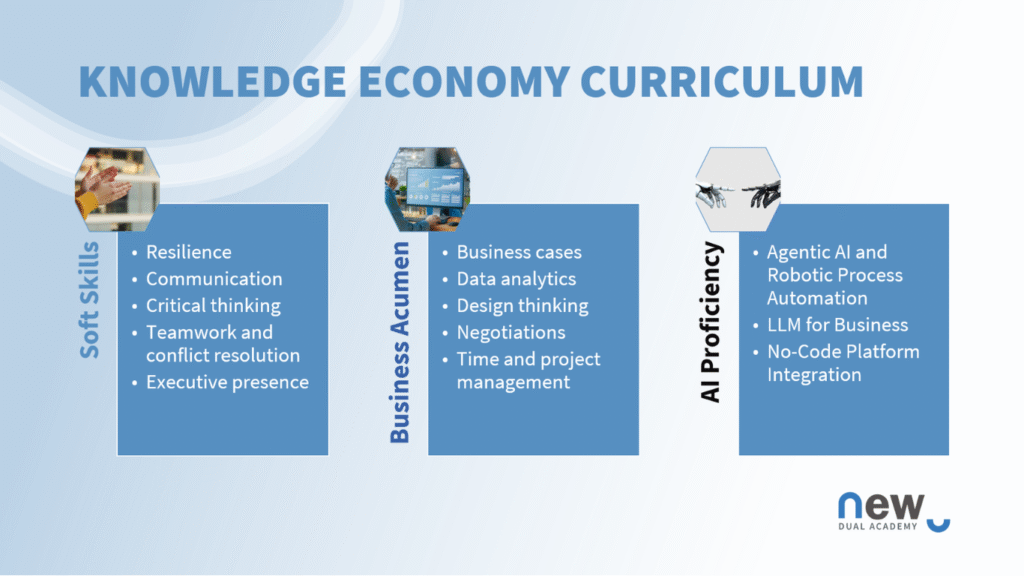
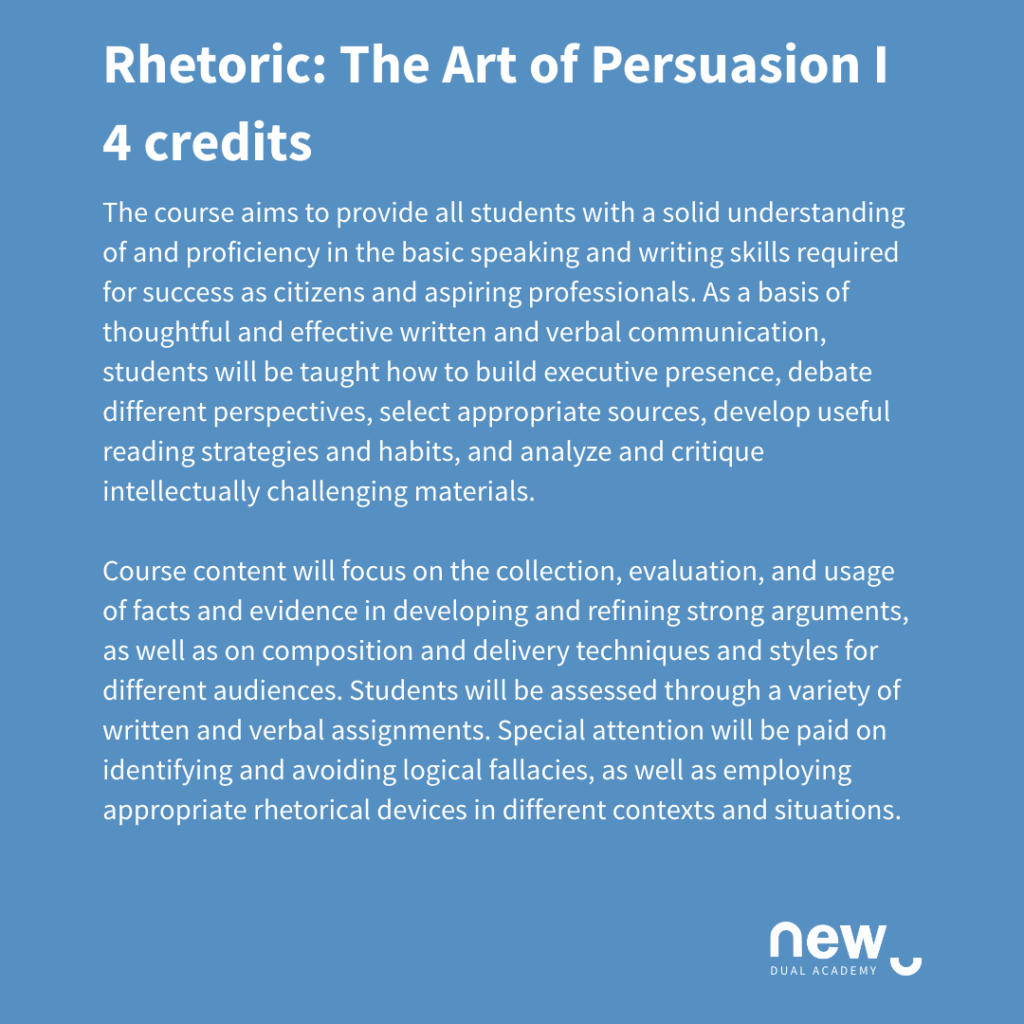
The course aims to provide all students with a solid understanding of and proficiency in the basic speaking and writing skills required for success as citizens and aspiring professionals. As a basis of thoughtful and effective written and verbal communication, students will be taught how to build executive presence, debate different perspectives, select appropriate sources, develop useful reading strategies and habits, and analyze and critique intellectually challenging materials.
Course content will focus on the collection, evaluation, and usage of facts and evidence in developing and refining strong arguments, as well as on composition and delivery techniques and styles for different audiences. Students will be assessed through a variety of written and verbal assignments. Special attention will be paid to identifying and avoiding logical fallacies, as well as employing appropriate rhetorical devices in different contexts and situations.
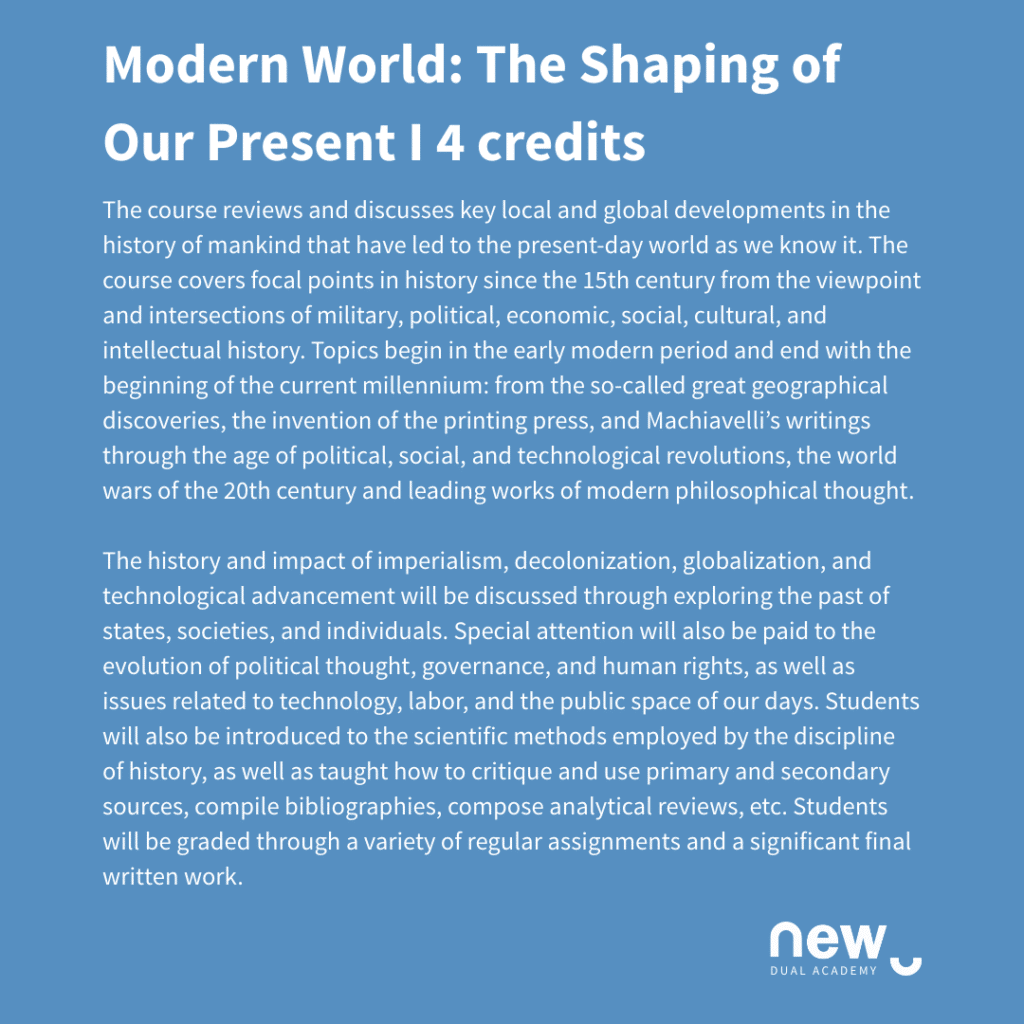
The course reviews and discusses key local and global developments in the history of mankind that have led to the present-day world as we know it. The course covers focal points in history since the 15th century from the viewpoint and intersections of military, political, economic, social, cultural, and intellectual history. Topics begin in the early modern period and end with the beginning of the current millennium: from the so-called great geographical discoveries, the invention of the printing press, and Machiavelli's writings through the age of political, social, and technological revolutions, the world wars of the 20th century and leading works of modern philosophical thought.
The history and impact of imperialism, decolonization, globalization, and technological advancement will be discussed through exploring the past of states, societies, and individuals. Special attention will also be paid to the evolution of political thought, governance, and human rights, as well as issues related to technology, labor, and the public space of our days. Students will also be introduced to the scientific methods employed by the discipline of history, as well as taught how to critique and use primary and secondary sources, compile bibliographies, compose analytical reviews, etc. Students will be graded through a variety of regular assignments and a significant final written work.
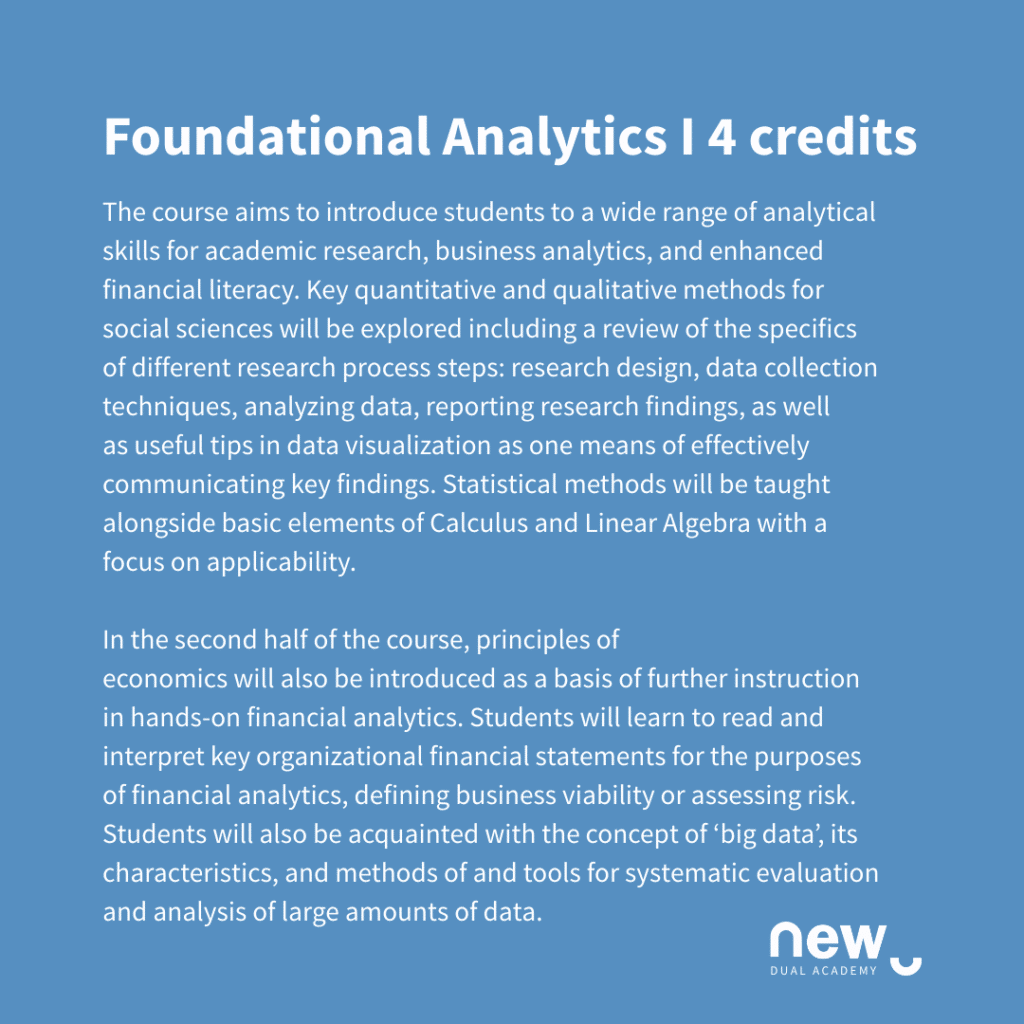
The course aims to introduce students to a wide range of analytical skills for academic research, business analytics, and enhanced financial literacy. Key quantitative and qualitative methods for social sciences will be explored including a review of the specifics of different research process steps: research design, data collection techniques, analyzing data, reporting research findings, as well as useful tips in data visualization as one means of effectively communicating key findings.
In the second half of the course, principles of economics will also be introduced as a basis of further instruction in hands-on financial analytics. Students will learn to read and interpret key organizational financial statements for the purposes of financial analytics, defining business viability or assessing risk. Students will also be acquainted with the concept of 'big data', its characteristics, and methods of and tools for systematic evaluation and analysis of large amounts of data.
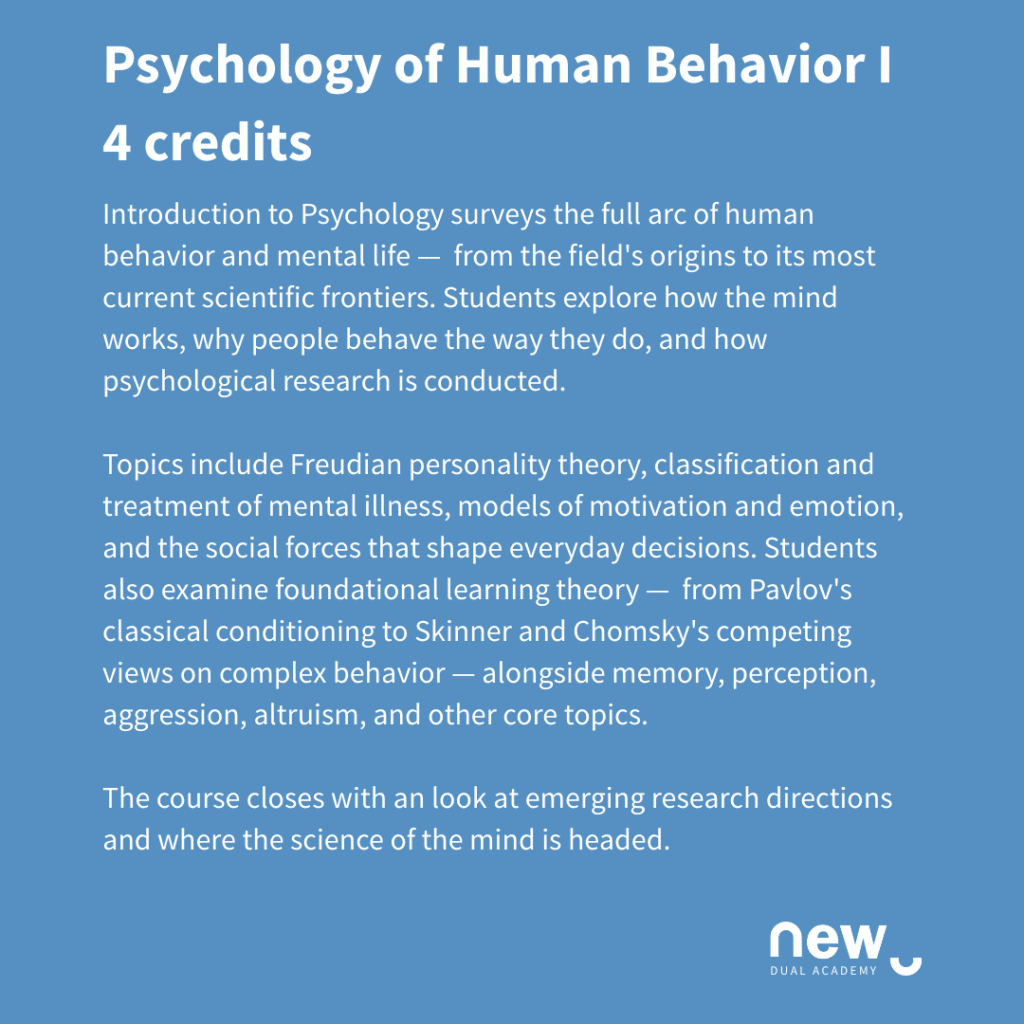
Introduction to Psychology surveys the full arc of human behavior and mental life, from the field's origins to its most current scientific frontiers. Students explore how the mind works, why people behave the way they do, and how psychological research is conducted.
Topics include Freudian personality theory, classification and treatment of mental illness, models of motivation and emotion, and the social forces that shape everyday decisions. Students also examine foundational learning theory, from Pavlov's classical conditioning to Skinner and Chomsky's competing views on complex behavior, alongside memory, perception, aggression, altruism, and other core topics.
The course closes with a look at emerging research directions and where the science of the mind is headed.
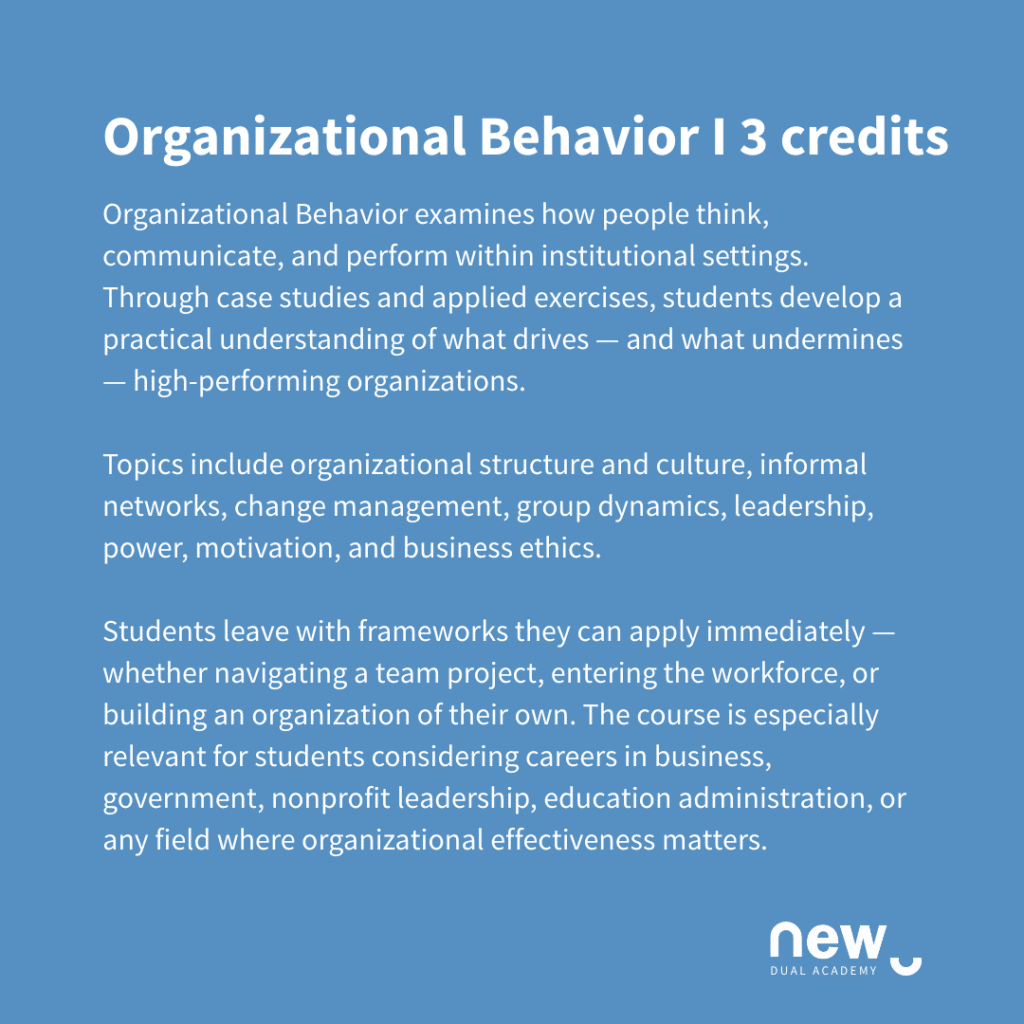
Organizational Behavior examines how people think, communicate, and perform within institutional settings. Through case studies and applied exercises, students develop a practical understanding of what drives high-performing organizations and what undermines them.
Topics include organizational structure and culture, informal networks, change management, group dynamics, leadership, power, motivation, and business ethics.
Students leave with frameworks they can apply immediately, whether navigating a team project, entering the workforce, or building an organization of their own. The course is especially relevant for students considering careers in business, government, nonprofit leadership, education administration, or any field where organizational effectiveness matters.
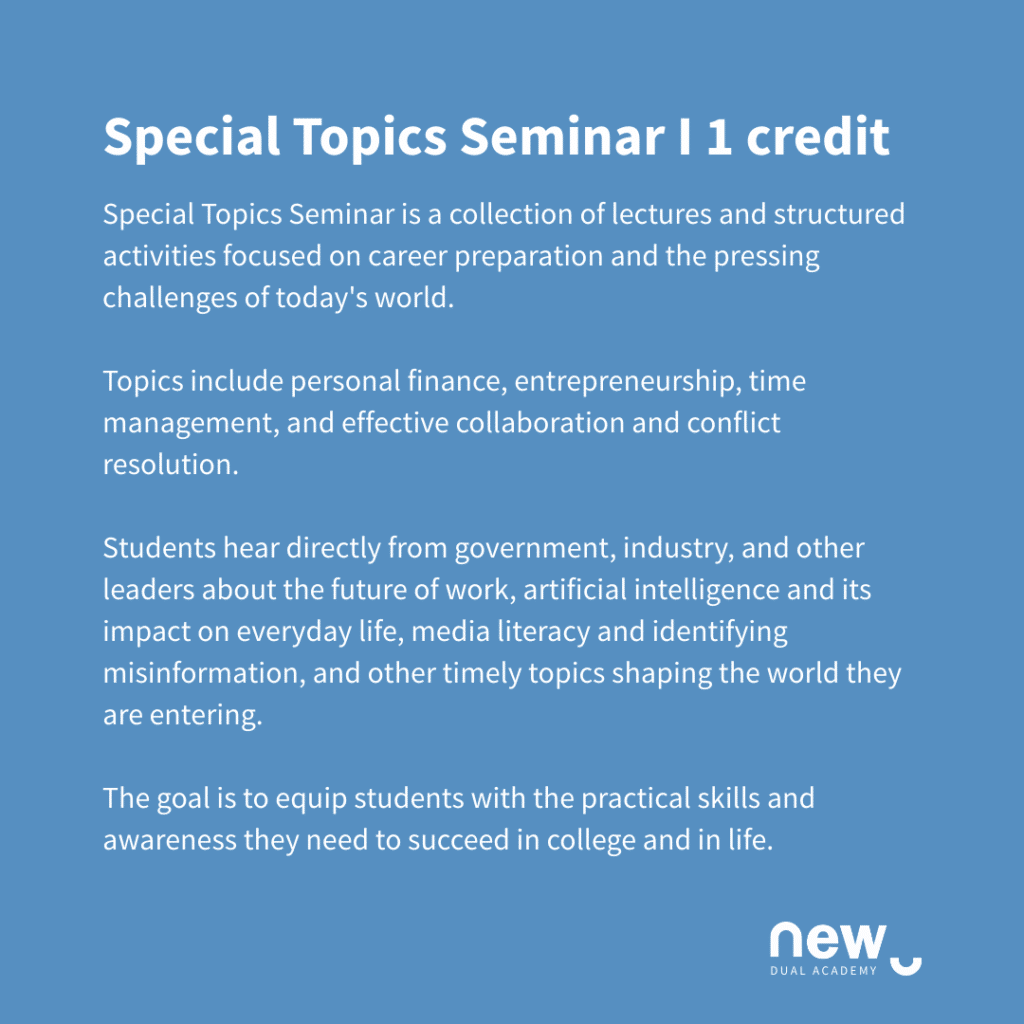
Special Topics Seminar is a collection of lectures and structured activities focused on career preparation and the pressing challenges of today's world.
Topics include personal finance, entrepreneurship, time management, and effective collaboration and conflict resolution.
Students hear directly from government, industry, and other leaders about the future of work, artificial intelligence and its impact on everyday life, media literacy and identifying misinformation, and other timely topics shaping the world they are entering.
The goal is to equip students with the practical skills and awareness they need to succeed in college and in life.
The course introduces the life sciences at the college level: the chemical and cellular basis of life, cell structure and function, energy and metabolism, cell division, the principles of genetics and molecular biology, the physiology of organisms, and the interactions of organisms with their environments. Students apply the scientific method to design experiments, collect and analyze data, and present conclusions supported by evidence. Laboratory investigations accompany the lectures.
The course introduces general chemistry at the college level: atomic structure, the periodic table and periodic trends, chemical bonding and molecular structure, chemical reactions and stoichiometry, gases, solutions, thermochemistry, reaction rates and equilibrium, and acids and bases. Students build quantitative problem-solving skills, practice measurement and safe laboratory technique, and apply chemical principles to materials, energy, medicine, and the environment. Laboratory investigations accompany the lectures.
The course teaches students how to display information effectively and avoid some common pitfalls in data visualization. Building on data analysis and user research skills developed in previous classes, students will learn principles of representing data and information in interactive mediums.
Course content discusses why and when certain behavior occurs, how it could be modified, and in what context this could happen. Students will be taught to undertake evidence-based approaches to design, implement, and evaluate interventions addressing a variety of real-life social problems relating to: lifestyle; nutrition; epidemiology and public health; transportation; mass communication; business, and economics.
This course examines how large language models (LLMs) such as GPT systems are transforming how organizations gather insights, make decisions, and communicate. Students learn practical applications of LLMs in marketing, operations, product design, and data analysis, with emphasis on prompt engineering, workflow integration, evaluation of model output, and responsible AI use. By the end of the course, each student builds a custom business use case leveraging an LLM to improve efficiency, creativity, or customer experience while ensuring privacy and fairness.
Global organizations work under a range of legal and regulatory frameworks and this course is designed to give an overview of these frameworks as they pertain to product innovation and management.
The class is an introduction to theories and methods of conducting market and user research. Through readings, discussions, and exercises, students will learn about research design, sampling, data gathering, and various quantitative and qualitative methods such as experiments, A/B testing, surveys, interviews and observations. Utilizing tools such as personas, use cases, scenarios and tasks, students will be able to apply ideation techniques that support user interface and user experience design.
Does my student have to attend live classes?
No. Live sessions and recordings are both available for every class. Your student can attend live (online from anywhere, but also on campus in Washington, DC if you’d like), watch the recordings, or both — whichever fits their schedule. The only thing on a schedule is the deliverables.
Is this dual enrollment?
Flex is college courses taken while you are still in high school, for transferable credit on a NewU University transcript. If you have been searching for dual enrollment, this is the program to compare.
Will the college credits transfer to other universities?
Yes. The credits come from NewU University, accredited by the Middle States Commission on Higher Education – the same kind of accreditation as Columbia, Georgetown, NYU, Rutgers, and UPenn, and most universities in the eastern U.S. Almost all U.S. colleges accept these credits.
What if we miss a live class?
You don’t miss anything. There’s no required attendance. Every session is available live and recorded – your student picks what works. What matters is the deliverables, which are due on a schedule.
Can we try just one class first?
Yes. Start with one class. Add more later if it’s a good fit.
Is there financial aid?
Not for Flex, but the volume discount works like one. Take one class and pay the standard rate. Take five in a semester and save up to 40% per credit.
Does my student get a high school diploma?
No. Flex is for college credits only; your current school decides whether to count them toward high school credit. If you want a high school diploma, check our other programs: Live or Campus.
Does my student have to go to NewU after finishing a class?
No. The admission letter is a standing offer your student can use anytime, or not at all. Most Flex students use their credits to get into or save money at other universities.
How big is the class?
Flex students join existing college classes at NewU University with full-time college students and other Flex students. Classes are intentionally small — every student gets individual attention from the professor.
Who teaches the classes?
College professors. Every Flex class is taught by a professor from NewU University – an academic or industry practitioner with college teaching experience. Same professors teach Dual Academy Live and Campus students, as well as the NewU University students.
Dual Academy is accredited by Cognia. Our partner university, NewU, is accredited by the Middle States Commission on Higher Education (MSCHE).