Mission
To make the shortest, most affordable path to a bachelor's degree available to every family in the U.S. and around the world.
Vision
A world where no family has to choose between a quality education and financial stability.
Values
Dual Academy Corp., doing business as NewU Dual Academy, is a Delaware Public Benefit Corporation. The terms "Dual Academy Corp.," "NewU Dual Academy," "Dual Academy," and "the school" are used interchangeably throughout this Handbook to refer to the same entity.
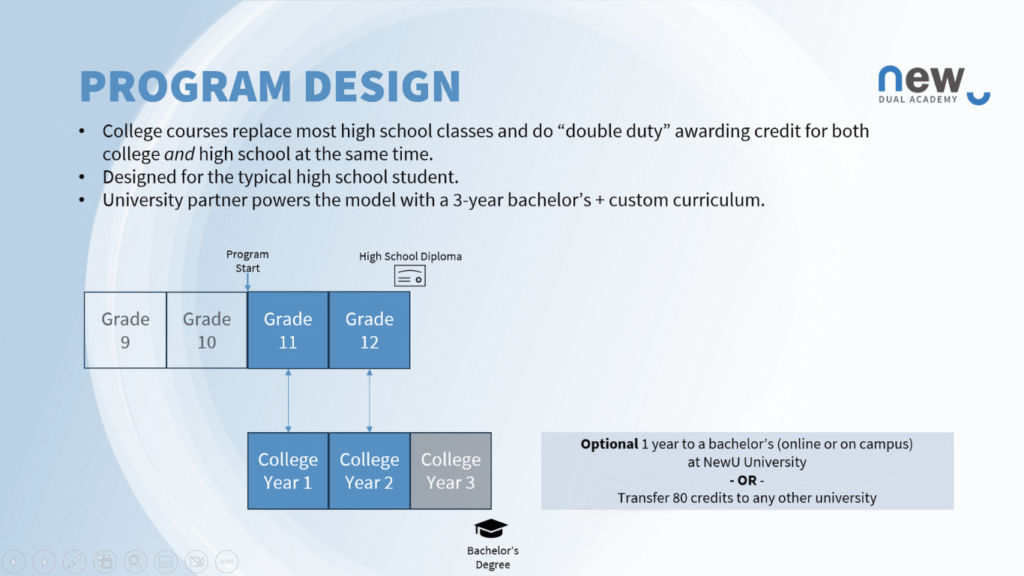
Dual Academy is an online and in-person high school for grades 11 and 12, with an à la carte course option open to students age 15 and older. Live and Campus students complete college courses that count toward both a Dual Academy high school diploma and a NewU University bachelor's degree. Flex students complete the same courses for NewU University college credit only and do not earn a Dual Academy diploma through Flex enrollment alone. Dual Academy is accredited by Cognia. Its partner institution, NewU University, is accredited by the Middle States Commission on Higher Education.
Dual Academy operates three delivery models: Live (real-time online, full-time enrollment, grades 11–12), Campus (in-person at 1400 16th Street NW, Suite 710, Washington, DC 20036, full-time enrollment, grades 11–12), and Flex (à la carte enrollment in Live courses, taken live or via recording, for students age 15 and older). Because Dual Academy courses are NewU University courses delivered to high school students, minor students are routinely present alongside adult college students in academic settings. This Handbook sets out the safeguarding and other policies that apply as a result.
Who This Handbook Applies To
This Handbook sets out the Dual Academy policies that apply to students and to parents and legal guardians. It applies in all environments operated by Dual Academy, including the Washington, DC campus, virtual classrooms, learning management systems, school-sponsored events, and school-related communications channels. Students, and the parents or legal guardians of minor students, acknowledge these policies at enrollment and at the start of each year. The school enrolls only students age 15 and older.
Compulsory Education
For DC-resident minor students, enrollment at Dual Academy satisfies the compulsory-attendance obligation under D.C. Code § 38-202. The District of Columbia does not register or license private schools. Dual Academy operates as a private school in the District in compliance with applicable District law, including annual enrollment data reporting to the Office of the State Superintendent of Education under D.C. Code § 38-205, attendance recordkeeping and truancy reporting under D.C. Code §§ 38-203 and 38-208, student health and immunization requirements under D.C. Code §§ 38–502 through 38-506 and 38-602 through 38-607, and mandated reporting of suspected child abuse under D.C. Code § 4-1321.02. Approval for attendance purposes under 5-E DCMR § 2100 is established through Cognia accreditation. For students resident in other jurisdictions, families confirm that enrollment at Dual Academy satisfies the compulsory-education requirements of their state of residence, with assistance from the Chief Student Journey Officer. Flex students remain enrolled at their primary school of record, or are otherwise responsible with their parents or legal guardians for compulsory-attendance compliance in their jurisdiction of residence. Enrollment in Flex does not, by itself, satisfy compulsory attendance.
Raising a Concern
You may raise a concern under any policy in this Handbook by contacting the Main Office at [email protected] or by mail to the address above. Concerns related to suspected child abuse or neglect must be reported immediately to the DC Child and Family Services Agency at 202-671-SAFE (7233), in addition to internal reporting.
Updates to These Policies
These policies may be updated from time to time. The version provided to you with your Enrollment Agreement is the version in effect at the time of your enrollment. Dual Academy makes the current version available to enrolled students and families through the school's student portal, notifies families of material changes, and provides a copy on request. Continued enrollment after notice of an update constitutes acceptance of the current version.
Policy numbering follows the Dual Academy Policy Manual. Some numbers are not used in this Handbook; gaps in the numbering are intentional and do not indicate missing content.
The following terms are used throughout this Handbook with the meanings set out below.
Child or Minor Student. A Dual Academy student under 18 years of age. The school enrolls only students age 15 and older. Child protection obligations under this Handbook (Policies 17, 18, 19, 23, and 24) apply to Minor Students. Reporting obligations under Policy 18 apply to suspected abuse, neglect, or boundary violations affecting Minor Students.
Adult Student. A Dual Academy student 18 years of age or older. Adult Students are subject to all Handbook policies that apply to students generally, including those addressing conduct (Policy 2), anti-discrimination (Policy 7), anti-bullying (Policy 21), anti-harassment and discriminatory conduct (Policy 22), the comingled environment (Policy 23), and acceptable use (Policy 25). Adult Students hold their own rights in NewU University postsecondary records from the start of enrollment.
Comingled Environment. Any setting in which Minor Students and Adult Students are present together, whether physical (the Campus) or virtual (Live and Flex courses).
Purpose
To translate the Code of Ethics into specific expectations for behavior by directors, employees, faculty, contractors, volunteers, and students, and to define the process for responding to violations.
Scope
Applies in every Dual Academy setting: the DC campus, virtual classrooms, learning management systems, school-sponsored events, transportation to or from school events, and school-related communications including email, messaging, and social media.
Expectations for Directors, Employees, and Contractors
Expectations for Students
Expectations for Parents and Legal Guardians of Minor Students
Progressive Response for Employees and Contractors
The President & CEO may bypass earlier steps for serious misconduct, including any conduct that endangers a student, any suspected child abuse, sexual misconduct, theft, fraud, or any conduct that creates legal or reputational risk.
Progressive Response for Students
Conduct that endangers others, involves academic fraud, or violates law may result in immediate suspension or dismissal without prior steps. Tuition refund follows the published refund schedule.
Investigations and Due Process
All credible reports are investigated promptly, fairly, and confidentially by a person without a conflict of interest. The accused is informed of the substance of the allegation and given an opportunity to respond, except where doing so would compromise an investigation involving suspected abuse or imminent safety risk. Findings, decisions, and outcomes are documented and retained under the school's records-retention policy.
Review
Reviewed by the President & CEO as needed, with comprehensive review every two years. Adopted May 2026.
Purpose
To affirm Dual Academy’s commitment to admit, educate, employ, and serve students, families, and staff without unlawful discrimination.
Policy
Dual Academy does not discriminate on the basis of race, color, national origin, ancestry, ethnicity, religion, sex, gender, gender identity or expression, sexual orientation, age, disability, marital or family status, pregnancy, genetic information, veteran or military status, source of income, or any other characteristic protected by federal, District of Columbia, or other applicable law in:
Statutory Framework
This Policy reflects the protections of the District of Columbia Human Rights Act, the Americans with Disabilities Act (Title III, public accommodations), and other applicable District of Columbia and state law. Matters involving sex-and gender-based conduct are handled under Policy 22.
Reasonable Accommodation
Dual Academy provides reasonable accommodations to qualified students and employees with disabilities consistent with the Americans with Disabilities Act and the District of Columbia Human Rights Act. Student accommodations are addressed under Policy 34. Employee and contractor accommodations are addressed under the school's workplace-conduct policy.
Reporting Discrimination
Concerns about discrimination are reported under the school's whistleblower and non-retaliation policy. Concerns involving harassment are also addressed under Policy 22.
Non-Retaliation
Retaliation against any person for raising a discrimination concern, requesting an accommodation, or participating in an investigation is prohibited and addressed under the school's whistleblower and non-retaliation policy.
Notice
Adopted policies are made available to those affected on the school's internal channels.
Review
Reviewed by the President & CEO as needed, with comprehensive review every two years. Adopted May 2026.
Purpose
To support student physical health on campus and to coordinate appropriate care in emergencies.
Scope
Applies to all on-site activities at the DC campus and to school-sponsored in-person events. Adapted procedures for virtual delivery are noted.
Health Records and Forms
For Campus students, at enrollment the parent or legal guardian of a minor student completes:
An adult Campus student completes the equivalent forms for themselves. Health records are not collected for Live or Flex students, who are not on site, and whose primary school of record holds any health file required by the law of their jurisdiction.
For every student, in every program, the school collects emergency contact information with at least two contacts, and authorization for the school to contact emergency services or request a wellness check where school personnel reasonably believe the student may be in imminent danger to themselves or others, including during a virtual session. These two items are not health records and are collected so that Policy 13 can be carried out.
First Aid and AED
The campus maintains a first-aid station and an automated external defibrillator at a visible, accessible location. Designated employees and faculty are trained and current in pediatric and adult first aid, CPR, and AED use. Training certificates are tracked by the Chief Student Journey Officer.
Emergency Response
In a medical emergency, school personnel call 911, render first aid within trained capacity, retrieve the AED if cardiac arrest is suspected, and contact a parent or legal guardian of a minor immediately. The Chief Student Journey Officer documents the incident, including the time, response, and disposition.
Illness on Campus
A student or employee who develops a fever, vomiting, diarrhea, or a contagious rash, or who presents with a communicable condition under Policy 11, is separated from others, supervised, and sent home. A parent or legal guardian of a minor is contacted to arrange pick-up. Return-to-school criteria follow Policy 11.
Wellness in Schedule and Workload
Course schedules, breaks, and homework expectations are calibrated to support healthy sleep, physical activity, and meals. Students are encouraged to use breaks for movement and meals.
Virtual Delivery
For Live, the instructor pauses or ends a session if a student appears to be in medical distress and contacts the Chief Student Journey Officer, who reaches the listed emergency contact and, if warranted, requests a wellness check from local emergency services.
Health Information Privacy
Student health information is treated as confidential education record material under the school's records-retention policy and the school's data-protection policy, shared only with employees with a legitimate educational interest or with the parent, legal guardian, or adult student. Faculty are informed of conditions on a need-to-know basis to support classroom safety.
Review
Reviewed by the President & CEO as needed, with comprehensive review every two years. Adopted May 2026.
Purpose
To prevent the spread of communicable disease in school settings and to respond effectively to outbreaks and pandemics.
Scope
Campus and in-person events. Virtual delivery is referenced where it is the continuity mechanism for in-person disruption.
Routine Prevention
Exclusion and Return
A student or employee with any of the following is excluded from on-site participation until criteria are met:
Excluded students may continue learning through the Live environment where they are well enough to do so.
Outbreak Response
Where multiple cases of a communicable disease occur in a short period, the Chief Student Journey Officer coordinates with the DC Department of Health, informs affected families and staff, increases cleaning, considers cohorting or temporary virtual delivery, and follows public health guidance.
Operational measures during an outbreak may include transition of Campus classes to Live delivery, modified instructional schedules, and, where determined by the President & CEO in consultation with the Department of Health, temporary closure of the Campus. During an outbreak of a vaccine-preventable disease, the school may exclude students with religious or medical exemptions to the relevant vaccine for the period determined by the District of Columbia Department of Health.
Pandemic Plan
In the event of a public health emergency, the President & CEO activates the Pandemic Plan, which includes:
Privacy
Health information is shared only as necessary to protect public health and is treated under the school's data-protection policy.
Review
Reviewed by the President & CEO as needed, with comprehensive review every two years. Adopted May 2026.
Purpose
To allow students who require medication during the school day to receive it safely on campus.
Default
Dual Academy does not stock or routinely administer prescription medications. Students self-manage their medications under parent or legal guardian instruction. School personnel may assist in narrowly defined circumstances under this policy.
Prescription Medications on Campus
A student who must take prescription medication during school hours brings it in the original pharmacy container with the prescribing clinician’s instructions. The parent or legal guardian (for minor students) submits a written authorization to the Chief Student Journey Officer that identifies the medication, dosage, schedule, route, and storage requirements.
Emergency Medications
Emergency medications such as epinephrine auto-injectors for severe allergy, rescue inhalers for asthma, or glucagon for diabetes are stored where the student can readily access them, with a duplicate held at the front office where applicable. Students 18 and older may self-carry. Minor students may self-carry where the parent or legal guardian and the prescribing clinician authorize self-carry in writing and the student has demonstrated the ability to self-administer.
Administration Assistance
Where a student requires assistance, only an employee specifically trained for that purpose may assist. The employee verifies the medication name, dosage, route, time, and student identity; documents administration in the medication log; and immediately reports any adverse reaction.
Over-the-Counter Medications
School personnel do not provide over-the-counter medications to students. A student may bring and self-administer over-the-counter medication with parent or legal guardian authorization on file.
Controlled Substances
Controlled substances brought to campus are stored in a locked cabinet accessible only to designated personnel and logged in and out at each dose.
Disposal and Return
Unused medication is returned to the parent or legal guardian at the end of the school year or at the end of the prescription, whichever is earlier. Medication is not disposed of by school personnel.
Documentation
Authorization forms, administration logs, and any incident reports are retained under the school's records-retention policy as part of the student health record.
Review
Reviewed by the President & CEO as needed, with comprehensive review every two years. Adopted May 2026.
Purpose
To support student mental health, to recognize and respond to signs of distress, and to act effectively when a student is at risk of suicide or self-harm.
Scope
All students and all delivery models. Adapted procedures for the in-person and virtual environments are noted.
Approach
Dual Academy is an educational institution, not a treatment provider. The school promotes a supportive environment, recognizes warning signs, intervenes in the moment of crisis, and connects students and families to professional resources.
Universal Practices
Recognition
Warning signs include statements about wanting to die, end the pain, or be a burden; significant changes in mood, sleep, or engagement; giving away possessions; withdrawal; increased risk-taking; references to suicide in writing or assignments; and direct disclosure to a peer or adult.
Response: Imminent Risk
If a student expresses an immediate plan or intent to harm themselves, or has begun self-harming:
Response: Concern Without Imminent Risk
When concern arises that does not rise to imminent risk:
Coordination with NewU University
Where the student is enrolled in NewU University courses and is also a minor, the Chief Student Journey Officer coordinates with the relevant NewU University point of contact while protecting student privacy under the school's data-protection policy.
Postvention
In the event of a suicide or attempted suicide affecting the school community, the President & CEO activates the postvention element of the school's emergency and crisis-response procedures, including counseling support, careful messaging consistent with safe-messaging guidelines, and avoidance of language or imagery that could increase contagion. Names and details are not shared without family consent and are not posted on school social media.
Records
Mental health response notes are retained as confidential student records under the school's records-retention and data-protection policies.
Review
Reviewed by the President & CEO as needed, with comprehensive review every two years. Adopted May 2026.
Purpose
To ensure that the Live environment is safe, orderly, and developmentally appropriate, especially given that some students in attendance are minors.
Scope
All synchronous and asynchronous instruction delivered through the learning management system, video conferencing platforms, course messaging, and any other school-sanctioned online environment.
Account and Identity
Classroom Conduct
Recording Controls
One-Way Visibility and Boundaries
Communications Channels
Intruder and Disruption Response
If an uninvited participant joins, or if a session is disrupted by inappropriate content or behavior:
Comingled Minor and Adult Student Considerations
Many Live sections contain both minor Dual Academy students and adult NewU University students. Instructors are informed of which students are minors before the term and apply this policy with that knowledge. Adult students are subject to Policy 23 and to all of the above conduct rules.
Accessibility
Where a student has an accommodation that adjusts the application of camera, microphone, or recording rules, the accommodation is documented under Policy 34 and honored without disclosure of the underlying condition to peers.
Review
Reviewed by the President & CEO as needed, with comprehensive review every two years. Adopted May 2026.
Purpose
To protect minor students from abuse, exploitation, neglect, and avoidable harm in every Dual Academy setting, and to make clear that safeguarding is the responsibility of every adult who serves the school.
Scope
Applies to every minor student of Dual Academy and to every director, officer, employee, faculty member, contractor, volunteer, advisor, and visitor who interacts with a minor student. Applies on the DC campus, in virtual classrooms, on school-sponsored trips and events, and on school-related communications channels.
Safer Recruitment
All hiring and contracting decisions that involve interaction with minor students follow the school's background-screening policy. Background screening, reference checks, and probationary monitoring are required.
Training
Addressed under the school's continuous-improvement policy.
Code of Conduct with Students
Adult-student boundaries are governed by Policy 19, which defines permitted interactions, prohibited interactions with minor students, physical contact, faculty office hours and tutoring, communications practices, reporting and response, disclosure of existing relationships, and training. Faculty, employees, contractors, advisors, volunteers, and adult students are subject to Policy 19 in full.
Supervision in the Campus Setting
Supervision in the Virtual Setting
Follows Policy 15. Faculty do not place minor students in private virtual rooms one-on-one outside scheduled, calendared, recorded office hours or without a second adult or parent or legal guardian notice.
Transportation and Off-Site Activities
The school does not provide routine transportation. For occasional school-sponsored off-site activities involving minor students:
Visitors, Vendors, and Volunteers
All non-employees who interact with minor students at the campus check in, are screened where ongoing access is contemplated under the school's background-screening policy, and are supervised. Vendor personnel performing one-time work do not have unsupervised contact with minor students.
Comingled Environment
Dual Academy students attend NewU University courses alongside adult college students. Specific safeguards in the comingled setting are addressed in Policy 23.
Reporting and Response
Reporting follows Policy 18. Internal response is coordinated by the Chief Student Journey Officer. The school cooperates fully with authorities and with NewU University.
Records
Safeguarding records, including investigation files, are retained permanently as restricted records under the school's records-retention policy.
Review
Reviewed by the President & CEO as needed, with comprehensive review every two years. Adopted May 2026.
Purpose
To ensure that suspected abuse, neglect, exploitation, or boundary violations affecting a minor student are reported to authorities and addressed internally without delay.
Scope
Applies to all directors, officers, employees, faculty, contractors, advisors, and volunteers of Dual Academy. All personnel with student contact are required by school policy to immediately report suspected abuse or neglect internally to the Chief Student Journey Officer, and externally to the appropriate child-protection authority where required by applicable law. Where state law makes the individual a mandated reporter, that statutory obligation governs the external report.
Definitions
Abuse. Physical, sexual, or emotional harm or threat of harm to a minor by an adult or older minor.
Neglect. Failure of a parent or caregiver to meet a minor’s basic needs (food, shelter, supervision, medical care) in a way that endangers the minor’s health or wellbeing.
Boundary Violation. Conduct by an adult toward a minor that violates Policy 19, whether or not it rises to abuse under the law.
Grooming. A pattern of behavior by an adult intended to build trust with a minor or family for the purpose of facilitating future abuse.
Mandated External Reporting
Information Reported
To the extent known, the reporter provides: the student’s name, age, address; the names and contact information of parents or legal guardians; the nature and extent of the suspected abuse, neglect, or boundary violation; the identity of the suspected perpetrator; the basis for the suspicion; and the reporter’s contact information.
Internal Reporting
In parallel with the external report, the reporter informs the Chief Student Journey Officer, who informs the President & CEO. If the suspected perpetrator is the President & CEO, the Chief Student Journey Officer informs the Chair of the Board. The school documents the report and the response.
Protection of Reporter and Student
Boundary Violations
Suspected boundary violations under Policy 19 that do not rise to abuse are reported to the Chief Student Journey Officer in writing. The Chief Student Journey Officer investigates under Policy 2 and takes action up to and including termination. Where conduct appears to cross into abuse, an external report is made.
False Reports
Reports made in good faith are protected even if not substantiated. Reports made knowingly false are addressed under Policy 2 and may be referred to law enforcement.
Confidentiality
Reports and related records are confidential. Access is limited to the Chief Student Journey Officer, the President & CEO, the Board where required, the investigating authorities, the school’s counsel, and the school’s insurer.
Training
Addressed under the school's continuous-improvement policy.
Review
Reviewed by the President & CEO as needed, with comprehensive review every two years. Adopted May 2026.
Purpose
To define professional boundaries between adults and minor students in every Dual Academy environment, and to make clear what is expected, permitted, and prohibited.
Scope
Applies to all employees, faculty, contractors, advisors, volunteers, and adult students whose presence in Dual Academy programs brings them into contact with minor students.
Core Principles
Permitted Interactions
Prohibited Interactions with Minor Students
Physical Contact
Faculty Office Hours and Tutoring
Communications Practices
Reporting and Response
Suspected boundary violations are reported under Policy 18. The Chief Student Journey Officer investigates under Policy 2. Outcomes may include training, reassignment, suspension, termination, and external report.
Disclosure of Existing Relationships
Any employee, faculty, contractor, or volunteer who has a prior personal, family, or close relationship with a minor student or with their parent or legal guardian discloses the relationship in writing to the Chief Student Journey Officer at hire or on the relationship becoming relevant. The Chief Student Journey Officer documents reasonable accommodations (such as reassignment of supervision) to avoid conflicts.
Training and Acknowledgment
Addressed under the school's continuous-improvement policy.
Review
Reviewed by the President & CEO as needed, with comprehensive review every two years. Adopted May 2026.
Purpose
To prevent and respond to bullying behavior so that every student can learn in a safe environment. This Policy meets the requirements of the District of Columbia Youth Bullying Prevention Act (D.C. Code § 2-1535.01 et seq.).
Scope
Applies to all students and to all conduct that takes place on the DC campus, in the Live environment, at school events, on school-related transportation, or through school accounts or channels, and to off-campus or off-platform conduct that has a substantial adverse effect on the school environment. Cyberbullying, which is bullying conducted through electronic means, including messaging, social media, online platforms, and any other digital channel, is within scope.
Definition
Bullying is severe, pervasive, or persistent conduct, including electronic conduct, by a student or group of students against a student, that is reasonably perceived as motivated by an actual or perceived characteristic of the targeted student and that:
Bullying includes cyberbullying conducted through electronic devices or accounts, whether or not on school equipment.
Prohibitions
Prevention
Reporting
Students, families, and personnel may report suspected bullying:
Reports are not delayed by the desire to gather complete information. Faculty who witness bullying intervene in the moment and report.
Response
Records
Bullying reports, investigation files, and outcomes are retained under the school's records-retention policy.
Review
Reviewed by the President & CEO as needed, with comprehensive review every two years. Adopted May 2026.
Purpose
To prohibit harassment and discriminatory conduct on the basis of any characteristic protected by the District of Columbia Human Rights Act or other applicable law, and to establish a clear, fair, and prompt process for responding to it.
Scope
Applies to every Dual Academy environment and to all students, employees, faculty, contractors, volunteers, vendors, and visitors.
Definitions
Harassment. Unwelcome conduct based on a protected characteristic under Policy 7 that is severe, pervasive, or persistent, and that creates a hostile, intimidating, or offensive environment or that materially interferes with educational or employment opportunity.
Sexual Harassment. Unwelcome sexual conduct, including unwelcome sexual advances, requests for sexual favors, sexual assault, dating violence, domestic violence, stalking, sex-based bullying, and other unwelcome sex-based conduct.
Quid Pro Quo. Conditioning a school benefit (such as a grade, recommendation, or participation in an activity) or an employment benefit on submission to unwelcome sexual conduct.
Retaliation. Any adverse action against a person who reports, supports, or participates in a process under this policy.
Reporting
Interim Measures
The Chief Student Journey Officer may offer interim measures to a complainant and a respondent regardless of whether a formal complaint is filed, including separation in classes, schedule changes, no-contact directives, counseling resources, and academic accommodations.
Response Process
Coordination With NewU University
Where a report involves a Dual Academy student and conduct that occurred in or arises from a NewU University course or program, the Chief Student Journey Officer notifies the corresponding contact at NewU University and the two institutions coordinate response under their respective procedures, with care to protect any minor and to share information only as permitted under the school's data-protection policy.
Outcomes
Findings of responsibility may result in remedial, educational, or disciplinary outcomes up to and including dismissal of a student or termination of an employee, under Policy 2. Interim measures continue as needed.
Non-Retaliation
Retaliation is prohibited and constitutes a separate violation.
Records
Investigation records are retained under the school's records-retention policy.
Coordination
Where conduct may also constitute discrimination under Policy 7, bullying under Policy 21, abuse under Policy 18, or a violation of Policy 19, the Chief Student Journey Officer coordinates with the relevant leaders to ensure each obligation is met.
Review
Reviewed by the President & CEO as needed, with comprehensive review every two years. Adopted May 2026.
Purpose
To set out the specific safeguards that apply because Dual Academy minor students study alongside adult college students enrolled at NewU University.
Scope
All Dual Academy courses, all NewU University courses in which a Dual Academy student is enrolled, and all school environments and channels in which both populations are present.
Disclosure
Code of Conduct in Shared Courses
All students in shared courses follow Policy 2 and Policy 22. Specific applications:
Faculty Awareness
Faculty teaching shared sections are informed of which students in their roster are minors and apply Policies 15 and 19 with that information. Course content remains at college level for every student. Where a specific assignment, activity, or material would be unsuitable for a minor student, the faculty member consults the Chief Academic Officer before assigning it.
Privacy
The identity of a student as a minor is treated as confidential under the school's data-protection policy and is shared only with personnel with a legitimate educational interest. Faculty do not disclose individual student ages in front of peers.
Off-Platform and Off-Hours
Adult students who become aware of an attempted off-platform contact with a minor student, of off-platform contact that has occurred, or of conduct that may violate this policy, are expected to report to the Chief Student Journey Officer or to [email protected].
FERPA at Postsecondary Level
For NewU University postsecondary education records, rights belong to the student upon enrollment in a postsecondary institution, regardless of the student's age. A parent or legal guardian wishing to access NewU University postsecondary records of a minor student obtains a written release from the student. The Dual Academy high school transcript and other Dual Academy records remain subject to the school's practices under the school's data-protection policy and Policy 27 for minor students. This distinction is acknowledged by the parent or legal guardian in the Enrollment Agreement or in the Terms of Enrollment accepted at enrollment, under Policy 28.
Supervision Outside the Classroom
For Campus students, the school’s responsibility for the student is limited to scheduled instructional periods and announced school programming. The school does not assume responsibility for the supervision of minor students outside scheduled instructional periods, on or off the Campus. For Live students, the school’s responsibility is limited to scheduled instructional periods and announced school programming conducted online.
Coordination with NewU University
Dual Academy and NewU University coordinate to ensure consistent application of conduct policies, parallel mandated reporting where required, and appropriate sharing of information about safeguarding incidents consistent with the school's data-protection policy.
Review
Reviewed by the President & CEO as needed, with comprehensive review every two years. Adopted May 2026.
Purpose
To define when and how photos, video, and audio of students may be captured, stored, and used, with particular care for minor students.
Scope
All school-related capture and use of student images and recordings, in any environment and through any device.
Consent for Marketing and Public Use
Photos, videos, or audio recordings of an identifiable minor student are used in marketing, on the website, in social media, in press releases, in published materials, or in any other external context only with prior written consent of a parent or legal guardian. Consent for adult students is obtained from the student. Consent forms identify the contemplated uses, the duration of the consent, the right to withdraw consent prospectively, and the process to request removal where feasible.
Use in Internal School Operations
Photos and recordings that are part of routine operations (such as recorded class sessions under Policy 15, identification photos in school systems, or attendance and security camera footage) follow the school's data-protection policy and Policy 15. They are not considered marketing or public uses and do not require Policy 24 marketing consent. Use of these recordings for any external or marketing purpose requires Policy 24 consent.
Photography and Recording at Campus and Events
Personal Devices and Social Media
Storage and Disposition
Photo and recording assets are stored on school-managed systems under the school's data-protection policy. Class recordings are retained for one academic year under Policy 15. Marketing assets featuring identifiable individuals are removed from active use on withdrawal of consent or on a written removal request, subject to prior good-faith use.
Compliance with Other Policies
Recording in connection with anti-harassment proceedings under Policy 22, child protection investigations, or law enforcement is governed by Policies 18 and 22 and may be lawful without consent where appropriate.
Review
Reviewed by the President & CEO as needed, with comprehensive review every two years. Adopted May 2026.
Purpose
To define how students, employees, faculty, contractors, and volunteers may use Dual Academy and NewU University information systems, accounts, and devices.
Scope
All school-issued accounts, email systems, learning management system, video conferencing, file storage, customer relationship management system, school networks, and devices.
Authorized Use
Account Security
Prohibited Activity
Recording, Capture, and Redistribution of Class Content
Class sessions, lecture recordings, transcripts, slides, assessments, and course materials are the property of the school and of NewU University. Enrollment gives a student a personal, non-transferable right to use them for their own study for as long as they are enrolled, and nothing beyond that.
The school records every class session and posts the recording and a full transcript to the class calendar event within a few hours of the session, so no student needs to capture a class independently. A student who needs course content in a different form, including under an accommodation, requests it at [email protected].
This section applies on personal devices and personal accounts as well as on school systems, and applies whether the student attends in real-time or watches a recording. A violation is addressed under Policy 52 and, where it involves the intellectual property of the school or of NewU University, under Policy 38.
Monitoring and Inspection
The school reserves the right, consistent with applicable law, to access, monitor, review, and inspect school-owned devices, systems, accounts, communications, recordings, logs, metadata, and storage used for school purposes. The school may monitor use of school systems and review school accounts and devices for legitimate operational, security, compliance, safeguarding, and investigative purposes. Routine monitoring is automated and aimed at security and reliability; targeted review of an individual account occurs on specific cause approved by the Chief Technology Officer in consultation with the President & CEO. School systems are intended for school purposes, and users do not have an expectation of privacy in their use of those systems. This policy is not intended to chill protected speech, including good-faith reports of misconduct, lawful concerted activity, or whistleblower communications under the school's whistleblower and non-retaliation policy.
Personal Devices
Personal devices used to access school data are configured under the school's data-protection policy (current operating system, encryption, screen lock, anti-malware). The school may require remote wipe of school data from a personal device on separation.
Departure
On separation, school accounts are disabled. School data on personal devices is returned or deleted under direction of the Chief Technology Officer.
Acknowledgment
All users acknowledge this policy at issuance of a school account.
Review
Reviewed by the President & CEO as needed, with comprehensive review every two years. Adopted May 2026.
The Dual Academy Privacy Policy is published at dualacademy.org/privacy and is incorporated into this Handbook by reference. It describes how Dual Academy collects, uses, shares, and protects personal information about students, parents, guardians, and visitors to the school’s website, and it governs education records, children’s privacy, data retention and security, artificial intelligence and automated processing, cookies and tracking, text messaging, and your rights and choices.
The version published at that address is the current and authoritative version. Where a printed or downloaded copy of this Handbook contains an earlier version of the Privacy Policy, the published version controls. The Privacy Policy states how a change to it is published and when it takes effect.
Questions, requests, or complaints regarding privacy should be directed to [email protected].
Review
Reviewed by the President & CEO as needed, with comprehensive review every two years. Adopted May 2026.
Purpose
To establish the standards and procedures by which Dual Academy admits and enrolls students into its three delivery models (Live, Campus, and Flex), so that admission decisions are fair, transparent, evidence-based, and consistent with the school’s mission and applicable law.
Scope
Applies to all admission and enrollment activity for Live, Campus, and Flex, including marketing intake, application review, enrollment, deferral, refunds, and the recordkeeping associated with each. Operates in conjunction with Policy 7 (Anti-Discrimination and Equal Opportunity), the school's data-protection policy (Cybersecurity and Data Protection) on student records, the school's background-screening policy (Background Screening) on staff with student contact, and Policy 27 (Privacy Policy) on applicant and student data.
Two Admission Pathways
Dual Academy operates two admission pathways. Full-time enrollment in Live or Campus requires a formal application, admission decision, and enrollment deposit. Flex enrollment is direct: any eligible student may enroll in one to five college classes per semester without an application. This Policy describes both pathways and the conditions that apply to each.
Eligibility for Live and Campus (Full-Time)
Grade level. Students enrolling in Live or Campus must be entering Grade 11 or Grade 12 in the academic year for which they apply. Final eligibility requires that the student have completed Grade 10 (for Grade 11 enrollment) or Grade 11 (for Grade 12 enrollment) by the end of the summer preceding enrollment. Live is available to students in the U.S. Eastern and Central time zones, with class sessions held on Eastern time; applicants outside those time zones are reviewed case by case where the schedule is workable from the applicant’s home time zone.
Academic record. Applicants submit a high school transcript covering completed coursework. Official, unofficial, and homeschool records are accepted. Submissions may be in the form of a PDF, scan, photograph, or screenshot. The school reserves the right to request additional documentation where the submitted record is incomplete or unclear.
Grade point average (unweighted). GPA standards are applied as follows: 3.0 to 4.0 qualifies for direct admission; 2.5 to 2.99 qualifies for provisional admission, which includes a brief online assessment or interview; below 2.5 is reviewed case by case. GPA standards are guidelines; the Chief Student Journey Officer may consider mitigating context, recent academic trajectory, and demonstrated readiness in any decision.
English proficiency. Instruction is delivered in English. Applicants whose primary language of instruction has not been English are expected to demonstrate sufficient English proficiency to engage with college-level coursework. The school does not require a specific standardized test score; the interview component of provisional admission serves as the proficiency check where needed.
Eligibility for Flex
Age. Flex is open to any student who will be age 15 or older on the day classes begin. There is no upper age limit. Flex students may be currently enrolled at a public school, private school, or homeschool program, or may be unenrolled.
Academic record. No transcript, application, or grade point average is required to enroll in Flex. The responsibility for assessing readiness rests with the student and, for minors, the parent or legal guardian.
Course selection. Flex students may enroll in one to five Dual Academy Flex classes per semester. Course offerings are published on the school website and refresh by semester. The school does not screen Flex course selections; the student and, where applicable, parent or legal guardian, make those choices.
Application Process for Live and Campus
Application. Applications are submitted online through the school website. The application takes approximately five to ten minutes to complete and may be submitted to Live, Campus, or both with a single submission. A non-refundable application fee, posted on the website, is paid at the time of submission.
Decision. Admission decisions are issued in writing within one week of a complete application. Complete means the application form, transcript, and application fee have been received. Incomplete applications are not reviewed; applicants are notified of any missing items.
Provisional admission. Applicants in the 2.5–2.99 GPA range complete a brief online assessment or interview as part of the admission process. Provisional admits enter on the same academic terms as direct admits and may have an initial academic check-in during their first semester.
Non-discrimination. Admission decisions are made consistent with Policy 7 (Anti-Discrimination and Equal Opportunity). The school does not discriminate in admissions on any basis protected by federal, District of Columbia, or applicable state law.
Enrollment for Live and Campus
Enrollment deposit. An admitted student secures their seat by paying an enrollment deposit, posted on the website, within the timeframe stated in the admission letter. The deposit is applied to first-semester tuition.
Enrollment agreement. Enrollment is finalized upon (i) payment of the deposit; (ii) execution by the student (if 18 or older) or by the parent or legal guardian (if the student is a minor) of the enrollment agreement, which acknowledges this Handbook and the school’s privacy and communications policies; and (iii) submission of any documents required by the school (such as health information and emergency contact forms under Policy 10).
Concurrent enrollment in NewU University. As a condition of enrollment, students are concurrently enrolled in NewU University for the college credit-bearing courses that form part of the Dual Academy curriculum. NewU University holds the postsecondary education record for those courses; rights in those records belong to the student from the start of enrollment, consistent with FERPA principles as adopted in the school's data-protection policy.
Withdrawal of admission. The school may withdraw an offer of admission or rescind enrollment where information submitted in the application is later found to be materially false or incomplete, where a final transcript shows performance materially below the basis for admission, or where conduct subsequent to admission would disqualify the student under the school’s conduct standards (Policy 2).
Enrollment for Flex
Direct enrollment. Flex enrollment is completed online through the school website. The student selects one to five courses for a semester, the parent or legal guardian (for a minor student) signs the enrollment form, and payment is processed at the time of enrollment. A monthly payment plan is available on request before enrollment.
Volume pricing. Per-credit tuition is published on the school website and is subject to a volume discount that increases with the number of classes taken in a single semester. The pricing in effect at the time of enrollment governs that enrollment.
Books and materials. Course materials reasonably necessary for completion of each Flex class are included in tuition. The school is not responsible for additional materials or technology costs that the student or family may incur.
Compulsory attendance. Flex enrollment does not, by itself, satisfy compulsory attendance in the student’s jurisdiction of residence. Flex students remain enrolled at their primary school of record (or, in the case of homeschool students, in the homeschool program registered with the relevant authority), and the family is responsible for compliance with any applicable compulsory attendance requirements. The school provides documentation of Flex enrollment and credit on request to support that compliance.
Refund and Deferral
Refund, cancellation, and deferral terms across all three delivery models are set out in Policy 29 (Tuition, Fees, and Refunds). The non-refundable application fee and the enrollment deposit are not subject to refund except where the school is unable to provide the program for reasons within its control.
Terms of Enrollment
All enrolled students, and parents or legal guardians of minor students, agree to the following terms as a condition of enrollment:
Communications and Privacy at Enrollment
At the time of application or enrollment, the school obtains opt-in consent to send email and text message communications to the student and to the parent or legal guardian of a minor student, on the contact information provided. Text messages relate to admissions, enrollment, classes, payments, academic progress, events, and program updates. Recipients may reply STOP at any time to opt out. For minor students, text messages are directed to the parent or guardian phone number. The school’s handling of personal information is governed by Policy 27 (Privacy Policy) and the school's data-protection policy (Cybersecurity and Data Protection).
Out-of-State and International Enrollment
Dual Academy enrolls students from across the United States (Live and Flex) and internationally (Flex). For students resident outside the District of Columbia, families are responsible for confirming that enrollment satisfies compulsory-education requirements in their state or country of residence. The Chief Student Journey Officer assists with that confirmation on request. The school monitors and complies with state-specific requirements for enrolling residents of states with active non-public school registration regimes; where state-specific requirements affect the school’s ability to enroll a particular applicant, the school communicates that to the applicant promptly.
Records and Confidentiality
Application materials, admission decisions, enrollment agreements, payment records, deferral and refund records, and related communications are retained as student records under the school's records-retention policy (Records Retention and Destruction) and treated as confidential under the school's data-protection policy. Applicants who do not enroll have their records retained for the period required by the school's records-retention policy and then disposed of securely.
Review
Reviewed by the President & CEO as needed, with comprehensive review every two years. Adopted May 2026.
Purpose
To establish how tuition and fees are set, communicated, and collected; how financial aid, discounts, and payment plans are administered; and how refunds, deferrals, and withdrawals affect what a family owes or is owed. This Policy supports affordability, predictability, and equitable treatment of families across all three delivery models.
Scope
Applies to all tuition, fees, financial aid, discounts, payment plans, refunds, and deferrals associated with enrollment in Dual Academy Live, Dual Academy Campus, and Dual Academy Flex. Operates in conjunction with the school's records-retention policy (Records Retention and Destruction) on financial records, Policy 7 (Anti-Discrimination and Equal Opportunity) on the administration of financial aid, and Policy 28 (Admission and Enrollment) on the procedural side of enrollment. Where Policy 28 and this Policy address the same topic, this Policy controls.
Annual Setting of Tuition and Fees
The President & CEO sets tuition rates, fees, the application fee, and the enrollment deposit. Approved rates are published on the school website and incorporated into the enrollment agreement for the applicable academic year. The rates in effect on the date a student enrolls govern that enrollment for the duration of the enrollment period covered by the agreement, unless the enrollment agreement provides otherwise.
Tuition and Fees for Live (2026–2027)
Tuition. $2,500 per semester. $5,000 per academic year.
Fees. $350 per semester. $700 per academic year. Fees cover platform, materials, assessment, and student services costs that are common across all enrolled students.
Total cost. $2,850 per semester. $5,700 per academic year. Equivalent monthly cost across a ten-month academic year: $570 per month.
Tuition and Fees for Campus (2026–2027)
Tuition. $7,500 per semester. $15,000 per academic year.
Fees. $750 per semester. $1,500 per academic year. Fees cover platform, materials, assessment, student services, and the in-person campus costs at the Washington, DC location.
Total cost. $8,250 per semester. $16,500 per academic year. Equivalent monthly cost across a ten-month academic year: $1,650 per month.
Tuition and Fees for Flex (2026–2027)
Per-credit rate. $150 per credit at the standard rate, reduced by volume discount as the number of classes per semester increases.
What is included. Tuition includes course materials reasonably necessary for completion of each class. There is no application fee for Flex. There are no additional fees.
Per-class pricing. Most Flex classes are four credits ($600 per class at the standard rate). Organizational Behavior is three credits ($450 per class at the standard rate). Special Topics Seminar is one credit ($150 per class at the standard rate).
Volume discount. Each class beyond the first reduces the per-credit rate by an additional 10% across all credits enrolled in the same semester, up to a maximum of 40% at five classes. Per-class semester totals at the four-credit class level: one class $600; two classes $1,080; three classes $1,440; four classes $1,680; five classes $1,800. Three-credit and one-credit classes produce proportional variances on the same rule.
Application Fee
An application fee of $25 is paid at the time the application is submitted for Live or Campus. The application fee is non-refundable, including where admission is denied, where the applicant withdraws, or where the applicant does not enroll. A single application fee covers a joint application to Live and Campus. Flex has no application and no application fee.
Enrollment Deposit
An admitted student secures their seat by paying an enrollment deposit of $300, within the timeframe stated in the admission letter. The deposit is applied to first-semester tuition. The deposit is refundable only where the school is unable to provide the program for reasons within its control. If the student does not enroll for the academic year for which they were admitted, the deposit is forfeited and the seat is released.
Payment Methods and Schedule
The school accepts payment by credit card and other electronic payment methods supported by the school’s payment processor. Tuition and fees for Live and Campus are payable on the schedule stated in the enrollment agreement. Tuition for Flex is payable at the time of enrollment, unless a monthly payment plan has been approved before enrollment. Receipts and statements are issued through the school’s billing system.
Monthly Payment Plans
Zero-interest monthly payment plans are available across all three programs at the discretion of the CFO. Families request a plan by writing to [email protected] before enrollment, and the plan terms are confirmed in writing. An approved plan is a binding payment schedule; missed installments are treated under the Failed Payments section below.
Flex payment plan deposit. A Flex monthly payment plan includes a non-refundable deposit of $100 per class per semester, due when the payment plan agreement is signed. The deposit reserves the student's seat in each class, is credited toward the semester total, and is not refunded once paid. The balance is paid on the installment schedule stated in the payment plan agreement. The fourteen-day full-refund cancellation window under Refunds for Flex below applies to enrollments paid in full at purchase and does not apply to a payment plan. Written cancellation to [email protected] within fourteen days of paying the deposit, or before the first day of classes for the semester, whichever comes first, cancels the remaining installments; the deposit is retained. From the first day of classes, or after the fourteen-day period if it ends sooner, the full semester total remains due on the schedule in the payment plan agreement, whether or not the student attends or completes classes. Where a payment plan agreement and this Policy address the same subject, the payment plan agreement controls.
Financial Aid
Need-based financial aid, hardship deferrals, and monthly payment plans are governed by Policy 30 (Financial Aid). Flex is not eligible for need-based financial aid; the Flex volume discount described above is the affordability mechanism for Flex.
Refunds for Live and Campus
A Live or Campus enrollment may be withdrawn without penalty up to 30 calendar days before the start of the student's first semester, by written notice to the Chief Student Journey Officer. In that case, all tuition paid is refunded; the application fee and enrollment deposit are not refunded except where the school is unable to provide the program for reasons within its control.
If withdrawal is requested less than 30 calendar days before the start of the first semester, or at any time after the first semester has begun, the student remains responsible for the entire first-semester tuition and fees, whether or not the student attends classes. The application fee and enrollment deposit are likewise not refunded.
For semesters after the first, withdrawal may be requested at any time by written notice to the Chief Student Journey Officer. Tuition for the then-current semester is forfeited; the student is released from tuition obligations for any subsequent semester.
These terms are incorporated into the enrollment agreement.
Refunds for Flex
Cancellation window. A Flex enrollment paid in full at purchase may be cancelled for a full refund of tuition, less actual payment processing fees of 2.9% plus $0.30 per transaction, within fourteen days of the enrollment purchase. The cancellation window closes at 12:00 a.m. Eastern Time on the first day of classes for the semester, even where fewer than fourteen days have elapsed since purchase. No refund is available on or after the first day of classes.
Payment plan enrollments. The cancellation window above applies to enrollments paid in full at purchase and does not apply to an enrollment on a monthly payment plan. A payment plan enrollment is governed by the deposit and cancellation terms under Monthly Payment Plans above and by the payment plan agreement itself.
After the cancellation window. Once the cancellation window closes, no refund is available, whether or not the student attends or completes the class. The enrollment may instead be deferred to a different Flex class under the deferral terms below, where the deferral request is made within the time permitted.
Deferrals for Flex
Deferral is available if requested before 12:00 a.m. Eastern Time on the first day of classes for the semester. The replacement class must be taken within twelve months of the original enrollment date. Where the replacement class is priced differently, the student pays the difference or receives a credit for the balance. A credit must be used within twelve months of the original enrollment date, has no cash value, and is not refundable. An enrollment may be deferred only once. A deferred enrollment that is not used within twelve months is forfeited.
How to Request a Refund or Deferral
Refund and deferral requests are submitted by email to [email protected] with the student's name and enrollment date. The school confirms deferrals by reply email and processes approved refunds promptly. The school maintains a written record of every refund or deferral request and the school's response, retained under the school's records-retention policy.
Failed Payments and Past Due Accounts
If a scheduled payment fails or an account becomes past due, the school notifies the family by email and provides a reasonable opportunity to cure. If the account remains unpaid after notice, enrollment may be paused; pausing enrollment suspends access to classes, the learning management system, and student services until payment is received. Paused enrollments that are not cured within a reasonable period may be terminated, with the financial effect of withdrawal as set out in the next section. Past-due accounts may be referred to collections.
The school does not withhold transcripts, grade reports, or diplomas as a debt collection tool. Transcripts and diplomas are issued regardless of the status of any past-due account, consistent with applicable federal regulation and as a matter of school policy.
Withdrawals and Their Financial Effect
For Live and Campus, the financial effect of withdrawal is set out in the Refunds for Live and Campus section above. For Flex, withdrawal during the cancellation window is treated as cancellation under the Refunds for Flex section; once that window has closed, and in every case on or after the first day of classes, no withdrawal-related refund is available, although deferral may be requested under the Deferrals for Flex section if the timing requirements are met.
Cancellation by the School
This subsection applies to all three delivery models. Where the school cancels a class or a program for insufficient enrollment or for any other reason, the affected student may elect either a substitute class or program where one is offered, or a full refund of tuition and fees paid for the cancelled class or program, including any payment processing fees and, for Live and Campus, the enrollment deposit. This subsection does not apply to a transition of Campus instruction to Live delivery, or to any other change in delivery method, which is not a cancellation.
Dismissal and Its Financial Effect
This subsection applies to all three delivery models. A student dismissed for a violation of the Code of Student Conduct under Policy 52, for an academic integrity violation under Policy 32, or for academic reasons under Policy 45 receives no refund and no credit for the then-current semester. Tuition already paid for the then-current semester is forfeited. The student is released from tuition obligations for any subsequent semester. Dismissal does not affect the school’s obligation to issue transcripts and diplomas under Policy 46.
Records and Confidentiality
All financial records associated with tuition, fees, financial aid, payment plans, refunds, and deferrals are retained under the school's records-retention policy and treated as confidential under the school's data-protection policy (Cybersecurity and Data Protection). Financial aid awards and family financial information are accessible only to personnel with a legitimate administrative need. Annual aggregated reporting of tuition revenue, aid awarded, and refunds processed is prepared for the Board as part of regular financial reporting.
Review
Reviewed by the President & CEO as needed, with comprehensive review every two years. Adopted May 2026.
Purpose
To make Dual Academy programs accessible to families across a wide range of financial circumstances by establishing the forms of financial aid the school offers, the criteria for awarding aid, and the procedures by which families apply and the school decides.
Scope
Applies to all financial aid administered by the school across the three delivery models. Pricing, refunds, and deferrals related to non-payment are governed by Policy 29 (Tuition, Fees, and Refunds). Operates in conjunction with the school's records-retention policy (Records Retention and Destruction) on financial records, Policy 7 (Anti-Discrimination and Equal Opportunity) on the administration of aid, the school's data-protection policy (Cybersecurity and Data Protection) on the handling of family financial information, and Policy 28 (Admission and Enrollment) on the procedural side of enrollment.
Forms of Financial Aid
Dual Academy offers three forms of financial aid plus a category for requests not covered by the other three:
Zero-interest monthly payment plan. Spreads tuition payments across the semester at no additional cost. Available across all three delivery models.
Need-based scholarship. Income-based reduction in tuition, up to fifty percent of tuition. Available to students enrolled in Live or Campus. Applied to tuition only; fees, the application fee, and the enrollment deposit are not eligible. Flex is not eligible for need-based scholarships; the Flex volume discount described in Policy 29 is the affordability mechanism for Flex.
Hardship deferral. Temporary postponement of a scheduled payment due to a documented financial emergency (such as job loss, serious illness, or other material change in family circumstances). Available across all three delivery models. A deferral postpones a payment; it does not reduce the underlying tuition obligation.
Other. Requests for aid arrangements not described above. The school considers other requests on a case-by-case basis and is not obligated to approve them.
Effect of a Need-Based Scholarship
The maximum award is fifty percent of tuition. At the maximum award, tuition is reduced for Live to a range of $1,250 to $2,500 per semester (approximately $250 to $500 per month) and for Campus to a range of $3,750 to $7,500 per semester (approximately $750 to $1,500 per month). Awards below the maximum reduce tuition proportionally. Fees remain payable in full. All families are encouraged to apply for aid regardless of income; awards are made on the basis of demonstrated financial need.
Eligibility
Zero-interest monthly payment plan. Any enrolled or admitted family may request a payment plan. Approval is at the discretion of the CFO and is based on the family’s ability to commit to a regular monthly schedule. Plans are typically structured across the months of the academic term.
Need-based scholarship. Open to families of students admitted to or enrolled in Live or Campus. Eligibility is based on demonstrated financial need supported by documentation.
Hardship deferral. Open to any enrolled family experiencing a documented financial emergency that affects the family’s ability to meet a scheduled payment on its original due date. The school evaluates the duration and amount of the deferral against the underlying hardship; a deferral is temporary by nature and not a substitute for a payment plan or a scholarship.
Application Process
Families apply for financial aid by completing the Financial Aid Application available on the school website. The application is submitted by a parent or legal guardian (or by the student where the student is an Adult Student), with a sworn signature certifying that the information and documents provided are true and accurate. The application is directed to the CFO at [email protected]. Questions about the application may be sent to the same address.
Documentation Requirements
Need-based scholarship. The school requests the family’s most recent federal tax return (IRS Form 1040, including a separate return for a spouse filing separately), and two recent pay stubs for each working household member. Social Security numbers may be redacted. Families may also submit additional documents that demonstrate household financial need, such as an unemployment notice, disability documentation, or other relevant records.
Hardship deferral. The school requests documentation of the hardship and its financial impact on the household. Examples: a termination letter with date, recent medical bills, an eviction notice, court documents, or other records that establish the nature and magnitude of the hardship.
Payment plan and Other. No documentation is required to request a zero-interest monthly payment plan. Supporting documents may be submitted with an “Other” request where they are relevant to the school’s evaluation.
Priority Deadlines for Need-Based Scholarships
Need-based scholarships are awarded on a rolling basis subject to the following priority deadlines for the upcoming academic year:
December 1. Secure your scholarship as offered.
March 1. Your scholarship offer may be reduced.
June 1. Your scholarship offer may be significantly reduced or no longer available.
Applications received after June 1 are reviewed only as funds remain available for the academic year. Payment plans and hardship deferrals are available year-round and are not subject to these priority deadlines.
Decision Process and Criteria
The CFO reviews each application against the eligibility criteria for the form of aid requested and the supporting documentation provided. Decisions are made on the basis of demonstrated need (for scholarships) or demonstrated hardship (for hardship deferrals) and are not based on any characteristic protected by Policy 7 (Anti-Discrimination and Equal Opportunity). Where a decision involves a material exception to standard criteria or an unusually large award, the CFO consults the President & CEO before issuing the decision.
Decisions are issued in writing within seven calendar days of the receipt of a complete application. Incomplete applications are returned with a list of the missing items; the seven-calendar-day clock starts on receipt of a complete application. Approved scholarships and deferrals are documented in writing with the award amount, the period covered, and any conditions.
Award Terms
Need-based scholarship. Awarded for one academic year at a time. A new application and current documentation are required for each subsequent year. Continued eligibility is not automatic. A scholarship may be reduced or revoked during the year only where the school learns that information submitted with the application was materially false or where a material change in family circumstances substantially increases household income; in either case the school provides written notice and a reasonable opportunity for the family to respond before reducing or revoking the award.
Hardship deferral. Approved for a defined postponement period stated in the decision letter. The deferred amount remains due at the end of the postponement period. The school does not assess interest or late fees during an approved deferral.
Zero-interest monthly payment plan. Confirmed in writing with a payment schedule. The schedule is binding; missed installments are treated under the Failed Payments section of Policy 29.
Non-Discrimination in Financial Aid
Financial aid decisions are made consistent with Policy 7. The school does not discriminate in the award, reduction, or revocation of aid on any basis protected by federal, District of Columbia, or applicable state law. Demonstrated financial need is the controlling criterion for need-based scholarships; demonstrated hardship is the controlling criterion for hardship deferrals.
Confidentiality of Family Financial Information
Financial documents submitted with an application, the school’s evaluation, and the award decision are confidential and accessible only to personnel with a legitimate administrative need. Family financial information is handled under the school's data-protection policy (Cybersecurity and Data Protection) and the school’s Privacy Policy (Policy 27). The fact that a student receives financial aid is not disclosed to faculty, classmates, or other families, and aid status does not appear in academic records or transcripts.
Records
Financial aid applications, supporting documentation, decision letters, and related correspondence are retained under the school's records-retention policy.
Review
Reviewed by the President & CEO as needed, with comprehensive review every two years. Adopted May 2026.
Purpose
To establish the academic structure of Dual Academy: curriculum framework, course offerings, graduation requirements, grading and academic progression standards, and the process by which the academic program is reviewed and updated. This Policy is the foundation on which Cognia accreditation, transcript issuance, and the school’s academic promises to families rest.
Scope
Applies to all coursework, assessment, grading, and credentialing across Live, Campus, and Flex. Operates in conjunction with the school's continuous-improvement policy (Continuous Improvement), Policy 28 (Admission and Enrollment), Policy 32 (Academic Integrity), and Policy 34 (Accommodations for Students with Disabilities).
Curriculum Framework
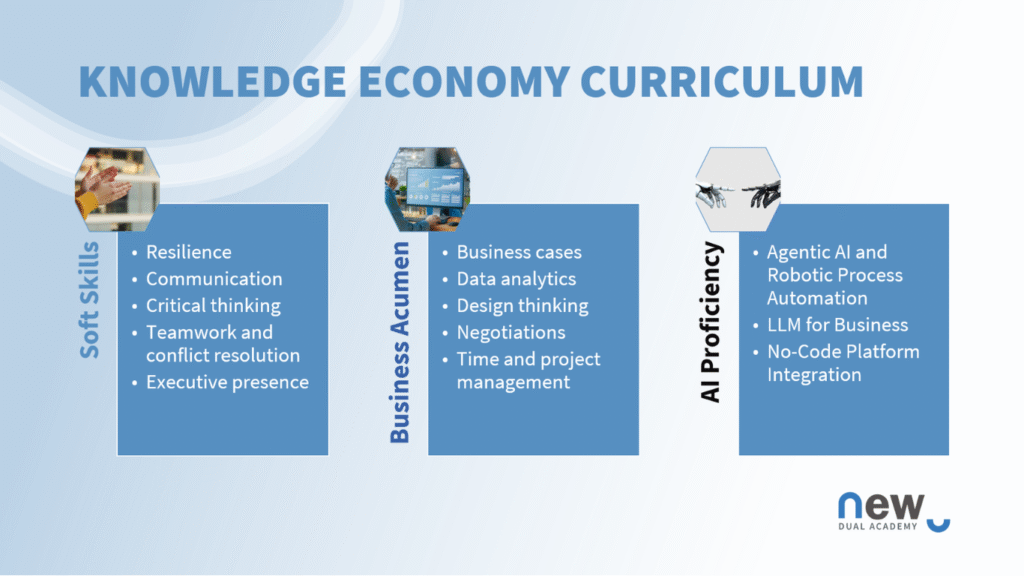
The Dual Academy curriculum is built on three pillars: soft skills, business acumen, and AI proficiency. The curriculum is delivered through college courses offered by NewU University and, for Live and Campus students, a small number of high school courses required for the Dual Academy diploma that are not satisfied by a NewU University college course. All courses are taught by college professors or, where a high school-only course is required, by a qualified high school teacher.
Live and Campus. Five college courses per semester that count for both high school and college credit, plus any high school courses needed to complete diploma requirements not covered by the college courses. The number and selection of additional high school courses are individualized to the student's prior Carnegie Units earned, as determined by the Chief Academic Officer. Students earn approximately 40 transferable NewU University college credits per academic year, for a total of approximately 80 college credits on the standard two-year path.
Flex. One to five college courses per semester, chosen by the student. Most courses are four credits; Organizational Behavior is three credits and Special Topics Seminar is one credit. Flex courses carry NewU University college credit and may also count for high school credit, but Flex students earn college credit only through Dual Academy; high school credit recognition for Flex courses is at the discretion of the student’s primary school of record.
Graduation Requirements (Dual Academy Diploma)
The Dual Academy diploma is a Washington, DC private high school diploma issued by Dual Academy to students who complete the full-time program (Live or Campus). A Flex enrollment alone does not lead to a Dual Academy diploma. To earn the diploma, a student must satisfy all of the following:
A student who does not meet all diploma requirements at the end of Grade 12 may, at the discretion of the Chief Academic Officer and consistent with applicable law, complete remaining requirements on a documented plan; until requirements are satisfied, the diploma is not issued.
Grading Scale
Dual Academy uses the following letter grade scale, with corresponding grade points used in unweighted grade point average calculations:
Non-grade marks used where appropriate: W (Withdrawal, no grade points, no credit), I (Incomplete, converts to a letter grade or F within the period established by the Chief Academic Officer), P/NP (Pass / No Pass, where the course is designated as Pass/No Pass in advance). Course grades reflect the standards published in each course syllabus by the assigned faculty.
Grade Reporting and Transcripts
Faculty enter course grades at the end of each semester. Semester grades, year grades, and cumulative grade point averages are available to students and to parents or legal guardians of minor students through the student records portal under the school's data-protection policy. Official transcripts are issued by the school on request, free of charge for current and recently enrolled students, regardless of the status of any past-due account. NewU University maintains the official college transcript for credit-bearing college courses; Dual Academy maintains the official high school transcript for the diploma.
Academic Progression
Good standing. A student in good standing maintains a cumulative grade point average of 2.0 or higher, is on pace to complete diploma requirements, and is in compliance with Policy 33 (Attendance) and Policy 2 (Code of Conduct).
The operational standards and process for academic warning, academic probation, dismissal for academic reasons, and readmission are set out in Policy 45 (Academic Standing).
Course Withdrawal and Repeat
A student may withdraw from a course before the published withdrawal deadline for the term and receive a W mark; the course does not affect grade point average but does not earn credit. A student may repeat a course in which a grade of D+ or below was earned; the higher grade replaces the original on the transcript for grade point average purposes, with both attempts shown. Course withdrawal that materially affects diploma progress requires consultation with the Chief Academic Officer.
Transfer Credit
Transfer credit from another school may be applied toward the Dual Academy high school diploma where the prior coursework is documented on an official transcript, is substantively equivalent to a Dual Academy required course, and is at or above the grade-level standard. Decisions on transfer credit are made by the Chief Academic Officer at the time of admission and are documented in the student’s record. Transfer credit toward NewU University college credit is handled by NewU University under its own policies.
Curriculum Review and Revision
The Chief Academic Officer leads an annual review of the curriculum, in coordination with NewU University as relevant to college-credit courses. Revisions are documented and communicated to families before they take effect. Material changes to graduation requirements take effect with the next entering cohort and do not retroactively change the requirements for students already enrolled. Curriculum review feeds into and draws from the Continuous Improvement work under the school's continuous-improvement policy.
Records
Course rosters, grades, transcripts, progression decisions, and curriculum review records are retained under the school's records-retention policy and treated as confidential education records under the school's data-protection policy.
Review
Reviewed by the President & CEO as needed, with comprehensive review every two years. Adopted May 2026.
Purpose
To protect the integrity of teaching, learning, assessment, and credentialing at Dual Academy by defining the standards of honest academic work expected of all students, the behaviors that violate those standards, and the process by which suspected violations are addressed.
Scope
Applies to all assessed work in all Dual Academy courses across Live, Campus, and Flex, and to academic interactions with NewU University as the school's partner institution. Operates in conjunction with the school's Code of Ethics (Code of Ethics), Policy 2 (Code of Conduct), Policy 25 (Acceptable Use of School Systems), and Policy 31 (Academic Program).
Definitions
Plagiarism. Presenting another person’s work, ideas, structure, or words as the student’s own without proper attribution. Includes copying from any source (printed, online, AI-generated, peer-submitted, or otherwise) without citation, submitting purchased or unauthorized ghostwritten work, and paraphrasing without attribution where the underlying idea is not the student’s own.
Cheating. Using or attempting to use unauthorized materials, information, technologies, or assistance during an examination, quiz, assignment, or other assessment; communicating with another person during an assessment in a manner not permitted by the faculty member; or submitting work prepared by another person as the student’s own.
Fabrication. Inventing, falsifying, or altering data, sources, citations, results, or experimental outcomes; misrepresenting attendance, participation, or completion of academic activities; or forging signatures or institutional documents.
Unauthorized collaboration. Collaborating with other students on an assignment, exam, or other assessment beyond what the faculty member has expressly permitted. Where collaboration is permitted, the scope and form of permitted collaboration are stated by the faculty member.
Facilitation. Knowingly assisting another student to engage in plagiarism, cheating, fabrication, or unauthorized collaboration. Facilitation is itself a violation of this Policy.
Use of Artificial Intelligence in Coursework
Dual Academy curricula include AI proficiency as a core skill. The school teaches students to use AI tools competently and ethically. In assessed coursework, the following standards apply:
Faculty members specify AI permissions on each assignment or in the course syllabus. Where the syllabus and an assignment differ, the assignment controls. Where neither addresses AI use, no AI use is permitted in submitted work.
Student and Faculty Responsibilities
Students. Students are responsible for understanding the standards of academic integrity in each course, including AI permissions, citation expectations, and the limits of permitted collaboration. A student in doubt about whether a planned action is permitted asks the faculty member before submitting the work.
Faculty. Faculty members state clear academic integrity standards in each syllabus, including AI permissions; design assessments that reflect the standards stated; remind students of the standards before significant assessments; and report suspected violations under the process below.
Procedure for Suspected Violations
Initial faculty review. The faculty member who suspects a violation reviews the work and the evidence, documents the concern in writing, and notifies the student in writing. The student may respond in writing or in a meeting with the faculty member.
Faculty determination. After hearing from the student, the faculty member makes an initial determination: no violation, minor violation, or material violation. A minor violation is handled by the faculty member with an academic consequence on the affected assessment (such as a zero or a required redo at a reduced grade) and a written record submitted to the Chief Academic Officer for the student’s file. A material violation is referred to the Chief Academic Officer for further review under the next subsection.
Chief Academic Officer review. For referred material violations, the Chief Academic Officer reviews the documentation, may interview the student, the faculty member, and other relevant witnesses, and issues a written decision. Possible outcomes include failure on the assessment, failure of the course, academic probation, dismissal under Policy 31, or referral to the disciplinary process under Policy 2 where conduct beyond academic integrity is also at issue.
Right of appeal. A student or, for a minor student, a parent or legal guardian may appeal the Chief Academic Officer's decision to the Head of School or a delegate. The Head of School or a delegate reviews the record and any new information and issues a written decision. The decision is final.
Repeat Violations
A repeat violation by the same student is treated more seriously than a first offense. The Chief Academic Officer considers prior documented violations when determining consequences. A pattern of violations may lead to dismissal under Policy 31.
Records
Academic integrity case files are retained as education records under the school's records-retention policy and the school's data-protection policy. Records of minor violations resolved by faculty action are retained in the student's academic file. Records of material violations resolved by the Chief Academic Officer or on appeal by the Head of School are retained in the student's disciplinary file.
Review
Reviewed by the President & CEO as needed, with comprehensive review every two years. Adopted May 2026.
Purpose
To establish attendance expectations across the school, the procedures by which attendance is recorded and communicated, and the school’s compliance with compulsory attendance and truancy reporting requirements in the District of Columbia and in other jurisdictions where the school enrolls students.
Scope
Applies to all enrolled students across Live, Campus, and Flex, with differentiation by delivery model as described below. Operates in conjunction with the school's records-retention policy (Records Retention), the school's data-protection policy (Cybersecurity and Data Protection) on attendance records, and Policy 31 (Academic Program) on the effect of attendance on academic standing.
Attendance Expectations
Live and Campus. Students are expected to attend all scheduled class sessions, Monday through Friday, for the duration of the published academic calendar. Class sessions are held on a regular school-day schedule on Eastern time. Live sessions are also available as recordings, but recording playback is a supplement to live attendance, not a substitute, for Live and Campus students.
Flex. Live sessions and recordings are available for every Flex course. Attendance at live sessions is flexible: a Flex student may attend live, view the recording, or both. The school records live attendance for information and engagement purposes but does not treat absence from a live Flex session as an unexcused absence. What is required of Flex students is timely submission of deliverables on the schedule set by the faculty member; chronic missed deliverables may affect course completion and credit under Policy 31.
Recordkeeping
Faculty take attendance for each live class session and enter attendance into the student information system. Attendance records include presence, tardiness, and absence (excused or unexcused), and are accessible to the student and to the parent or legal guardian of a minor student through the student records portal under the school's data-protection policy. Attendance records are retained as education records under the school's records-retention policy.
Absences and Tardiness
Excused absences. An absence is excused where the parent or legal guardian (for a minor student) or the student (where 18 or older or otherwise an Adult Student) notifies the school in advance, or as soon as practicable, with a reason that fits the school’s criteria. Excused absences typically include illness, medical or dental appointments, religious observance, death or serious illness in the immediate family, court appearances, and school-approved educational activities. The school may request documentation for extended absences.
Unexcused absences. An absence is unexcused where the student is absent without advance notification or a valid reason. Unexcused absences accumulate toward the truancy thresholds described below.
Tardiness. Arrival after the start of a class session is recorded as tardy. Three tardies in a given course in a single semester are treated as one unexcused absence for recordkeeping purposes. Habitual tardiness may be addressed under Policy 2 (Code of Conduct) and considered in academic standing under Policy 31.
Truancy Reporting
Truancy reporting follows the law of the student’s jurisdiction of residence. For DC-resident minor students, the school complies with D.C. Code §§ 38-203 and 38-208:
For students resident outside the District of Columbia, the school cooperates with the student’s state of residence to support compulsory attendance and truancy compliance where the family’s primary school of record is Dual Academy. Where Dual Academy is not the primary school of record (Flex students), compulsory attendance compliance rests with the family and the primary school.
Communication with Families
The Chief Student Journey Officer or designee contacts the family of a minor student promptly upon an unexpected or unexplained absence; if the family cannot be reached, the emergency contact is notified. Communication with families regarding attendance concerns is documented in the student record.
Effect on Academic Standing and Credit
Excessive absence (excused or unexcused) may make it impossible for a student to complete the work required for credit. A student who misses more than fifteen percent of class sessions in a course (excused or unexcused, combined) is subject to individualized review by the Chief Academic Officer, which may result in a make-up plan, a course withdrawal, or course failure under Policy 31. Long-term excused absences (medical or family emergency) are handled with a documented continuity plan where possible.
Records
Attendance records, communications with families about attendance, truancy reports, and make-up plans are retained under the school's records-retention policy and treated as confidential education records under the school's data-protection policy.
Review
Reviewed by the President & CEO as needed, with comprehensive review every two years. Adopted May 2026.
Purpose
To provide equal access to the Dual Academy program for students with disabilities consistent with the Americans with Disabilities Act (Title III, public accommodations), the District of Columbia Human Rights Act, and applicable District of Columbia and state law.
Scope
Applies to all enrolled and admitted students with documented disabilities across Live, Campus, and Flex. Operates in conjunction with Policy 7 (Anti-Discrimination), Policy 10 (Health Services and Wellness), the school's data-protection policy (Cybersecurity and Data Protection) on disability records, Policy 22 (Anti-Harassment and Discriminatory Conduct), and Policy 31 (Academic Program).
Definitions
Disability. A physical or mental impairment that substantially limits one or more major life activities, a record of such an impairment, or being regarded as having such an impairment, consistent with the Americans with Disabilities Act.
Reasonable accommodation. A modification or adjustment to the academic environment, instructional methods, assessment, or related services that enables a student with a disability to participate in and benefit from the Dual Academy program on an equal basis. An accommodation is reasonable where it does not fundamentally alter the nature of the program or impose an undue burden on the school.
Digital Accessibility
The Live program, the school website, the student information system, and learning platforms follow accessibility best practices, with Web Content Accessibility Guidelines (WCAG) 2.1 conformance as an ongoing improvement target. The Chief Technology Officer maintains an accessibility roadmap and addresses identified gaps on a documented schedule.
Physical Accessibility
The Washington, DC campus is selected and operated with attention to physical accessibility. Identified accessibility issues are addressed by the Chief Financial Officer through the building’s management or through capital improvements as appropriate.
Non-Discrimination
Dual Academy does not discriminate in admission or enrollment on the basis of disability. Admission decisions are made on the basis of the criteria in Policy 28, without regard to disability status. Students with disabilities have the same rights to participate in academics, student support services, and school-sponsored activities as all other students.
Requesting an Accommodation
A student, or the parent or legal guardian of a minor student, requests an accommodation by contacting the Chief Student Journey Officer in writing. Requests may be made at admission, at enrollment, at the start of an academic term, or at any time during enrollment as needs arise.
Documentation. The school requests documentation of the disability and the basis for the requested accommodation. Acceptable documentation includes a recent psychoeducational evaluation, a current Individualized Education Program (IEP) or accommodation plan from a prior school, a medical evaluation from a qualified provider, or other evidence appropriate to the nature of the disability. Documentation is reviewed for currency and relevance; older documentation may be accepted where the disability is stable.
Interactive process. Once a request is received, the Chief Student Journey Officer engages the student and family, with the Chief Academic Officer, in an interactive process to identify accommodations that meet the student’s needs in the Dual Academy program. The interactive process may include consultation with the student’s evaluator (with consent), with faculty, and with NewU University as relevant to college-credit courses.
Decision and Accommodation Plan
The Chief Academic Officer issues a written accommodation decision in a reasonable time, in consultation with the Chief Student Journey Officer. An approved accommodation plan states the accommodations, the courses or activities to which they apply, the period they cover, and any conditions. The plan is shared with the student, the parent or legal guardian of a minor student, and with affected faculty on a need-to-know basis.
Examples of Accommodations
Accommodations vary with the disability and the student. Examples include:
Review and Renewal
An accommodation plan may be modified at any time on request of the student or family, or on the initiative of the Chief Academic Officer where the student's needs have changed. A new plan is issued in writing where material changes are made.
Grievances
A student or family who believes the school has not properly handled an accommodation request, denied a reasonable accommodation, or otherwise discriminated on the basis of disability may file a grievance under Policy 44.
Confidentiality and Records
Disability documentation, accommodation requests, and accommodation plans are confidential and treated as education records under the school's data-protection policy. Information is shared with faculty and other personnel only on a need-to-know basis sufficient to implement the accommodations. Records are retained under the school's records-retention policy.
Review
Reviewed by the President & CEO as needed, with comprehensive review every two years. Adopted May 2026.
Purpose
To set out the support services Dual Academy provides to students alongside academic instruction: coaching and academic advising. These services exist to help students grow academically, develop professionally, and stay connected to mental health and crisis resources when they need them.
Scope
Applies to all enrolled students, with services differentiated by delivery model where appropriate. Operates in conjunction with Policy 13 (Mental Health and Suicide Prevention), the school's data-protection policy (Cybersecurity and Data Protection), Policy 17 (Child Protection and Safeguarding), Policy 19 (Adult-Student Boundaries), and Policy 27 (Privacy Policy).
Coaching for Success
Frequency and format. Every Live and Campus student is assigned a coach who meets one-on-one with the student on a regular cadence determined by the coach in consultation with the student. Sessions are scheduled by the coach and may be held online or in person depending on the program and the student's preference. The coach is a member of the school's faculty or staff trained in advising and mentoring. Flex students do not receive coaching as a standard service; course-level academic support is provided by the course faculty.
Scope. Coaching covers academic progress, time management, study skills, career exploration, and the student’s overall experience at the school. Coaches help students stay on track toward graduation and toward their college and career goals. Coaches are not licensed mental health providers; where a student's needs exceed what coaching is designed to address, the coach connects the student with appropriate community mental health resources and, where Policy 13 or Policy 22 applies, with the Chief Student Journey Officer.
Confidentiality. Coaching conversations are treated as confidential within the school’s education record system under the school's data-protection policy, with the limits common to all school relationships with minor students: a coach who learns of suspected child abuse, neglect, or boundary violation reports under Policy 18; a coach who learns of imminent risk of harm responds under Policy 13; a coach who learns of an academic integrity concern reports under Policy 32. Coaches do not promise confidentiality that they cannot keep.
Documentation. Coaches document each session at a level appropriate to the conversation: the date, the topics discussed, action items, and any follow-up. Documentation is part of the student’s education record under the school's data-protection policy.
Academic Advising
Academic advising sits with the assigned coach for Live and Campus students and covers course selection, college-credit progress, transcript planning, NewU University articulation, and the path to bachelor’s degree completion. For Flex students, the Chief Student Journey Officer or designee is available on request for course selection guidance. Advising decisions that affect graduation requirements are confirmed in writing with the student and family.
Records
Coaching notes, academic advising records, accommodation plans (cross-referenced under Policy 34), and consent forms are retained under the school's records-retention policy and treated as confidential under the school's data-protection policy.
Review
Reviewed by the President & CEO as needed, with comprehensive review every two years. Adopted May 2026.
Purpose
To establish how the Dual Academy name, marks, and intellectual property are used; how the school respects the intellectual property of others; and how works created in the course of school activity are owned and licensed. This Policy protects the corporate brand, supports the partnership with NewU University, and ensures Dual Academy meets its contractual and legal obligations on intellectual property.
Scope
Applies to all directors, officers, employees, faculty, contractors, advisors, volunteers, students, parents and legal guardians, vendors, sponsors, and any other party authorized or seeking to use the school’s name, marks, or content, or to create or distribute content within or on behalf of the school.
Names and Marks
The school operates under three names, each with a distinct use:
The brand palette, typography (Source Sans 3), logo, and color values are defined in the brand standards maintained by the President & CEO. Variants, modifications, or recoloring of the logo are prohibited absent written approval of the President & CEO.
Official Use
Officers, employees, faculty, contractors, and student or family communications that represent the school use the names and marks consistent with the brand standards and the use guidance above.
The President & CEO or designee approves new uses on collateral, signage, advertising, partner co-branding, and merchandise before publication.
Third-Party Use
External use of the names, marks, or logos by sponsors, vendors, partners, and other outside entities requires a written license from the school. Recognition of a sponsor or partner is permitted where it acknowledges the relationship; uses that suggest school endorsement of a product or service that the school has not endorsed are not permitted. Requests are submitted to the President & CEO.
The relationship with NewU University is governed by the Master Agreement and the Trademark License Schedule. References to NewU University on Dual Academy materials follow that license. Use of the NewU University marks outside that license requires the written consent of NewU Inc.
Private and Personal Use
Use of the names and marks in connection with a personal project, a non-school commercial venture, a political campaign, or any activity that could be construed as school endorsement is prohibited. Faculty and staff who maintain personal websites, social media accounts, or external publications follow Policy 25 and identify personal statements as their own.
Domains, Handles, and Email
Dual Academy controls the dualacademy.org domain and the school’s social media handles. Officers, employees, and faculty do not register domain names, social media handles, app store accounts, or email addresses that reference Dual Academy, NewU Dual Academy, or any school program without written approval of the President & CEO. Accounts and credentials are owned by the school and are returned at end of employment or engagement.
Copyright Compliance
The school respects the intellectual property rights of others. Personnel and students download, store, and use copyrighted material only as authorized by license, by fair use, or by other lawful basis. The school does not tolerate unauthorized copying or distribution of copyrighted media, software, or course content. Faculty rely on library and database licenses for course readings and verify clearance for materials reproduced in instruction. Any DMCA takedown notice is routed to the Chief Technology Officer and addressed under the school's data-protection policy.
Ownership of Work Product
Work product created by an officer, employee, or contractor in the course of engagement, or using school resources, is owned by Dual Academy Corp. The terms of the Intellectual Property and Invention Assignment Agreement signed at engagement govern. This includes curriculum, course materials, marketing content, internal documentation, software, and student-facing communications produced for the school.
Faculty Scholarly Work
Faculty members retain copyright in scholarly works (articles, books, conference papers) produced as part of their academic work, consistent with academic norms. Faculty grant the school a non-exclusive, royalty-free license to use, reproduce, and distribute such works for instructional and operational purposes within the school. Course materials developed for, customized for, or substantially funded by the school are owned by the school under the preceding paragraph; coursework that is essentially a faculty member’s pre-existing scholarly work is treated as scholarly work.
Student Work
Students retain copyright in original work they produce as part of their coursework. By enrolling, students and parents or legal guardians grant the school a non-exclusive, royalty-free license to use, reproduce, and display student work for accreditation, instructional improvement, internal training, and limited promotional purposes, subject to Policy 24 on identifiability and consent. Use of student work in external publications beyond these purposes requires the written consent of the student, and of the parent or legal guardian where the student is a minor.
Trademark Protection and Enforcement
The school monitors for unauthorized use of its names and marks. Suspected infringement is reported to the President & CEO. The school will, in its discretion and with the advice of counsel, take action against infringement that creates a risk of confusion or harm to the brand.
Records and Confidentiality
Brand standards, license records, takedown notices, and infringement correspondence are retained under the school's records-retention policy and treated as confidential under the school's data-protection policy.
Review
Reviewed by the President & CEO as needed, with comprehensive review every two years. Adopted May 2026.
Purpose
To provide students and families with a clear, fair process for raising concerns and appealing decisions of the school, separate from the discrete processes set out elsewhere in this Handbook for safeguarding, harassment, academic integrity, and accommodations.
Scope
Applies to all enrolled students of Dual Academy across Live, Campus, and Flex, and to parents and legal guardians of minor students. This Policy operates alongside, and does not replace, the dedicated processes in:
A grievance that falls under one of those policies is handled under the dedicated process.
Informal Resolution
Many concerns are best resolved by direct conversation with the person closest to the issue: the faculty member for a course concern, the coach for an advising or progress concern, or the Chief Student Journey Officer for a campus, enrollment, or records concern. Students and families are encouraged to raise concerns informally before initiating a formal grievance.
Formal Grievance
A formal grievance is initiated by written submission to the Chief Student Journey Officer at [email protected] with the subject line "Grievance" and the following content: the name of the student, the nature of the concern, the steps already taken to resolve it informally where applicable, and the outcome the student or family seeks. Anonymous grievances are accepted but limit the school's ability to investigate and respond.
Investigation and Response
The Chief Student Journey Officer acknowledges the grievance, investigates, and issues a written response. The response sets out findings and any corrective action.
Appeal
A student or, for a minor student, a parent or legal guardian may appeal the Chief Student Journey Officer's decision to the Head of School or a delegate. The Head of School or a delegate reviews the record and any new information and issues a written decision. The decision is final within the school's internal process.
Grievances Concerning the Head of School
A grievance that concerns the Head of School is submitted to the President & CEO. Where the Head of School and the President & CEO are the same person, the grievance is submitted directly to the Chair of the Board.
Grievances Concerning the President & CEO
A grievance that concerns the President & CEO is submitted directly to the Chair of the Board. The Chair, or a committee of the Board excluding the President & CEO, investigates and decides the grievance. The Board's decision is final within the school's internal process.
No Retaliation
Retaliation against a student or family for raising a good-faith grievance is prohibited under the school's whistleblower and non-retaliation policy. The school protects the confidentiality of grievances under the school's data-protection policy, subject to the school's reporting and disclosure obligations.
Internal Exhaustion
All disputes between a student or family and the school must be exhausted through this Policy and any other applicable internal policy before any external action is initiated. The school's enrollment agreement governs the resolution of any dispute that remains after internal exhaustion. This provision does not limit a student's or family's right to complain to Cognia or, where applicable to NewU University postsecondary credit, the Middle States Commission on Higher Education or the District of Columbia Higher Education Licensure Commission.
Records and Confidentiality
Grievance records are retained under the school's records-retention policy and treated as confidential under the school's data-protection policy.
Review
Reviewed by the President & CEO as needed, with comprehensive review every two years. Adopted May 2026.
Purpose
To establish how the school monitors student academic progress, places students on academic probation when progress is insufficient, dismisses students whose progress does not recover, and considers requests for readmission. This Policy is the Dual Academy companion to the NewU University academic standing rules that govern the postsecondary side of students' college coursework.
Scope
Applies to all enrolled Dual Academy students in Live, Campus, and Flex. Specific rules are calibrated by delivery model.
Standards of Academic Progress
A Live or Campus student is making satisfactory academic progress when they:
A Flex student is making satisfactory progress when they pass each enrolled Flex class consistent with NewU University academic standing rules. Flex does not have a cumulative GPA threshold at the school level beyond the postsecondary rule.
Academic Warning
A student whose progress in any term falls below the satisfactory threshold but who is not yet subject to probation receives a written academic warning from the Chief Academic Officer or designee. The warning identifies the concern, the actions expected of the student, and the support available. Academic warning is not a sanction; it is an early notice.
Academic Probation
A student is placed on academic probation when one of the following occurs:
The student receives a written probation notice setting out the conditions for return to good standing, the academic plan, and the timeline (typically the next term). The student and family acknowledge the notice. Probation is not by itself a denial of enrollment for the following term, but it is a documented condition.
Dismissal
A student is subject to academic dismissal when one of the following occurs:
The Chief Academic Officer issues the dismissal in writing, with the President & CEO concurring. The notice identifies the basis, the effective date, and the right to appeal under Policy 44. A dismissed student is withdrawn from current courses; the financial effect follows Policy 29.
Appeal of Probation or Dismissal
A student or family may appeal a probation or dismissal decision under Policy 44.
Readmission
A dismissed student may apply for readmission after one full academic year from the effective date of dismissal. The readmission application requires:
Readmission, if granted, is conditional on a specified academic plan for the first term back. A second dismissal forecloses further readmission absent exceptional circumstances approved by the President & CEO.
Voluntary Withdrawal
A student may withdraw voluntarily at any time under Policy 29. Voluntary withdrawal does not by itself preclude future enrollment, subject to the admission requirements in Policy 28.
Records and Confidentiality
Academic standing records are retained under the school's records-retention policy and treated as confidential under the school's data-protection policy.
Review
Reviewed by the President & CEO as needed, with comprehensive review every two years. Adopted May 2026.
Purpose
To establish how Dual Academy issues transcripts, awards transfer credit toward graduation, and issues the high school diploma. NewU University maintains the postsecondary academic record for college credit earned under the Master Agreement.
Scope
Applies to all current and former Dual Academy students across Live, Campus, and Flex, and to applicants requesting evaluation of prior credit.
Transcripts
Dual Academy issues high school transcripts for Live and Campus students. The transcript shows courses, grades, credits earned, cumulative GPA, dates of attendance, and graduation date where applicable. NewU University issues postsecondary transcripts for college coursework, including for Flex students, on its own schedule. Transcript requests are submitted to the Chief Student Journey Officer. Requests for transcripts of minor students require the consent of the parent or legal guardian; for students 18 or older, the student’s own consent is required, consistent with Policy 27.
No Transcript or Diploma Holds
The school does not withhold transcripts, grade reports, or diplomas as a debt collection tool, and does not condition the issuance of any academic credential on the payment of any past-due account. This applies to both the Dual Academy high school transcript and the NewU University postsecondary transcript, and applies regardless of the amount, duration, or status of any past-due account. The school may pursue past-due accounts through other means under Policy 29, including suspension of access to ongoing services and referral to collections.
Transfer Credit In
Credit earned at another accredited high school or accredited college may be applied toward the Dual Academy diploma, subject to evaluation by the Chief Academic Officer. The evaluation considers:
Decisions on transfer credit in are documented and shared with the student and family in writing. Disagreements may be appealed under Policy 44.
Transfer Credit Out
For NewU University coursework, NewU University evaluates transfer credit out to receiving institutions consistent with its own articulation arrangements and the standards of the Middle States Commission on Higher Education. The school does not guarantee acceptance of any course by any specific receiving institution; transfer credit decisions belong to the receiving institution.
Graduation Requirements and Diploma Issuance
Graduation requirements for the Dual Academy diploma are set out in Policy 31. A student who has met the graduation requirements is issued a Dual Academy diploma signed by the President & CEO. The diploma identifies the school as Dual Academy and notes the college-credit pathway with NewU University.
A student who has completed the graduation requirements is issued a diploma regardless of the status of any past-due account. A student with a pending matter under Policy 52 (Student Discipline) may have diploma issuance deferred pending the written resolution of that matter under Policy 52, with the deferral limited to misconduct grounds and not based on any financial obligation. A student dismissed under Policy 45 is not issued a diploma based on the work completed before dismissal except where the Chief Academic Officer determines that the student substantially completed the requirements.
Flex Students
A Flex student does not earn a Dual Academy high school diploma through Flex enrollment alone, as set out in the Introduction and Scope of this Handbook. A Flex student earns NewU University college credit for completed Flex coursework, reflected on the NewU University transcript.
Records and Confidentiality
Transcripts, credit evaluations, and diploma records are retained under the school's records-retention policy and treated as confidential under the school's data-protection policy.
Review
Reviewed by the President & CEO as needed, with comprehensive review every two years. Adopted May 2026.
Purpose
To set out the school’s expectations regarding student substance use and to confirm a smoke-free and vape-free environment across all school locations and activities. Employee provisions are in the school's workplace-conduct policy; this Policy addresses students.
Scope
Applies to all enrolled students of Dual Academy across Live, Campus, and Flex, in all school environments, including the Washington, DC campus, the virtual learning environment, school-sponsored events, and school-related travel.
Substance-Free Environment
The unlawful manufacture, distribution, possession, sale, or use of controlled substances by any student in any school environment is prohibited. This applies regardless of the student’s age, the legal status of any substance under DC law, or the legal status of any substance under the law of the student’s state of residence. Federal law applies to school operations and to the postsecondary credit-bearing aspect of the program.
The use or possession of alcohol by any student under twenty-one years of age in any school environment is prohibited. Students twenty-one years of age or older do not use or possess alcohol in school environments except at a documented school-sponsored event for adult attendees where the President & CEO has approved alcohol service in advance, and where minor students are not present in the area where alcohol is served.
The use of cannabis, including under any state-law recreational or medical authorization, in any school environment is prohibited.
Prescription Medication
A student who needs prescription medication during the school day, on campus, or during school activity follows Policy 12. The presence of a prescription does not authorize impairment in class or in school-sponsored activity.
Smoke-Free and Vape-Free
All school environments are smoke-free and vape-free, including tobacco, electronic cigarettes, and vaping devices, regardless of substance vaporized. This applies to the Campus interior and exterior areas under the school’s control, the virtual learning environment where the camera shows or implies use, school-sponsored events, and school-related travel. State and local smoking laws apply at all locations; the school’s standard is at least as strict.
Reasonable Suspicion and Response
A staff member who has reasonable suspicion that a student is under the influence in a school environment notifies the Chief Student Journey Officer and the President & CEO. The school’s response prioritizes safety and includes, as appropriate, removal from the immediate activity, notification of the parent or legal guardian for minor students, medical attention where indicated, and a documented follow-up with the student and family.
Discipline
Violations are subject to discipline under Policy 2 and may result in suspension or expulsion. For repeat or severe violations, the President & CEO may convene a review under Policy 45 or refer the matter to law enforcement where the conduct involves illegal activity. Treatment and counseling resources are offered as appropriate to support student recovery and continued education where the school determines continued enrollment is appropriate.
Education and Support
The school provides age-appropriate education about substance use, including the risks associated with alcohol, tobacco, vaping, cannabis, and other substances. Faculty and staff who teach or advise minor students are trained on identifying signs of substance use and on the response described above.
Records and Confidentiality
Substance-related incident records are retained under the school's records-retention policy and treated as confidential under the school's data-protection policy. Records involving minor students are handled consistent with Policy 18 reporting where indicated and Policy 27 privacy protections.
Review
Reviewed by the President & CEO as needed, with comprehensive review every two years. Adopted May 2026.
Purpose
To establish the planning, supervision, consent, and safety requirements for school-sponsored activities that take place outside the Washington, DC campus and outside the virtual learning environment.
Scope
Applies to any school-sponsored activity that involves enrolled students traveling to, or assembling at, a location other than the DC campus or the virtual learning environment. Includes day field trips, multi-day trips, off-campus events, conferences, competitions, and school-sponsored travel. This Policy supplements, and does not replace, the school's safety and security plan (Safety), Policy 17 (Child Protection), Policy 19 (Adult-Student Boundaries), the school's background-screening policy (Background Screening), Policy 23 (Comingled Minor and Adult Student Environment), and Policy 47 (Substance Use and Smoke-Free Environment).
Approval
Off-campus activities are proposed in writing to the President & CEO with the following information: purpose, educational connection, dates and times, destination and venue, transportation, supervising adults, supervision ratio, estimated cost, and any heightened safeguarding considerations. The President & CEO approves before the activity is communicated to families or scheduled.
Supervision Ratios
Day activities involving minor students require at least one supervising adult for every eight minor students, with a minimum of two adults. The supervising adults are employees, contractors, or screened volunteers of the school. Multi-day and overnight activities involving minor students require at least one adult for every six minor students, with a minimum of two adults of whom at least one is the same gender as the participating minor students where the group is single-gender or where lodging arrangements require it. All supervising adults complete background screening under the school's background-screening policy before the activity.
Parental Consent (Minor Students)
A signed parental or guardian consent form is required before a minor student participates. The consent form identifies the activity, destination, dates, transportation, supervising adults, emergency contact, and any known risks. A general blanket consent at enrollment does not substitute for activity-specific consent for off-campus travel beyond the local DC metro area, for any overnight activity, or for any activity involving heightened risk.
Emergency Contact and Response
The supervising adult carries an activity-specific emergency packet that includes emergency contacts for each participant, emergency contacts for the school (President & CEO, Chief Student Journey Officer), medical information and any medication authorizations under Policy 12, the nearest emergency medical facility at the destination, and an incident-response card. Emergencies follow the school's emergency and crisis-response procedures.
Transportation
School-sponsored transportation uses commercial carriers or licensed drivers operating school-approved vehicles. Drivers undergo background screening under the school's background-screening policy where they will transport students. Personal vehicles of staff or chaperones are not used to transport unrelated minor students.
Boundaries and Safeguarding
Adult-student boundaries under Policy 19 apply in full to off-campus activities. The heightened safeguarding considerations of the comingled environment under Policy 23 apply where adult students are present alongside minor students. Overnight activities require additional protocols: separate lodging for adults and minor students, no one-on-one adult-minor lodging or transportation, and a documented accountability check at each lodging transition.
Substance-Free Environment
Policy 47 applies in full to off-campus activities. Alcohol is not present at any off-campus activity that includes minor students, regardless of local law.
Insurance
The CFO confirms that insurance under the school's insurance and risk-management policy covers the planned activity, secures any rider required, and lists the destination venue as additional insured where required by the venue.
Cancellation and Refunds
The school may cancel an off-campus activity at any time for safety, health, or operational reasons. Family payments toward the activity are refunded in proportion to costs not yet committed, on the schedule communicated when the activity was approved.
Records and Confidentiality
Activity plans, consent forms, incident reports, and post-activity reviews are retained under the school's records-retention policy and treated as confidential under the school's data-protection policy.
Review
Reviewed by the President & CEO as needed, with comprehensive review every two years. Adopted May 2026.
Purpose
To set out a simple, fair process for responding to student conduct violations.
Scope
Applies to non-academic conduct violations by enrolled students across Live, Campus, and Flex, including violations of Policies 2, 17, 18, 19, 21, 22, 23, 25, and 47. Academic discipline is governed by Policy 32 (Academic Integrity) and Policy 45 (Academic Standing). Mandatory external reporting of suspected child abuse follows Policy 18 and is not affected by, or contingent on, the internal disciplinary process set out below.
Reporting and Investigation
The Chief Student Journey Officer receives reports of suspected conduct violations and conducts a fact-finding inquiry. The student is informed of the report and given an opportunity to respond. The parent or legal guardian of a minor student is informed and given an opportunity to respond before any sanction beyond a verbal warning is imposed.
Sanctions
Sanctions are proportionate to the conduct and may consider prior violations. Available sanctions include:
The Chief Student Journey Officer decides sanctions up to and including short-term suspension. Long-term suspension and expulsion are decided by the President & CEO. Sanctions are documented in writing and provided to the student and, for a minor student, the parent or legal guardian, with a written explanation of the violation, the sanction, the effective dates, and the grievance route under Policy 44.
Grievance and Final Decision
A student or parent who disputes a sanction may file a written grievance under Policy 44.
External Recourse
Subject to the internal exhaustion requirement in Policy 44, this Policy does not limit a student's or family's right to complain to Cognia or, where applicable to NewU University postsecondary credit, the Middle States Commission on Higher Education or the District of Columbia Higher Education Licensure Commission.
Records and Confidentiality
Disciplinary records are retained under the school's records-retention policy and treated as confidential under the school's data-protection policy, subject to the school’s mandatory reporting obligations.
Review
Reviewed by the President & CEO as needed, with comprehensive review every two years. Adopted May 2026.
Purpose
To set expectations for the use of artificial intelligence and generative tools by students, faculty, and staff in Dual Academy’s academic and administrative environments.
Scope
Applies to all uses of generative AI tools, including large language models, image, video, and audio generators, code assistants, and AI-augmented research tools, by students, faculty, and staff in connection with Dual Academy activities. NewU University AI policies apply to NewU-administered postsecondary courses; this Policy applies in addition to and consistent with those policies.
Students
Each faculty member specifies in the course syllabus the expectations and ground rules for student use of AI tools in that course. Students follow the syllabus rules of the faculty teaching the course. Use of AI tools in a manner not permitted by the syllabus is treated as an academic integrity violation under Policy 32.
Faculty
Faculty may use AI tools to support content generation, including lesson planning, sample problems, scaffolding materials, slides, and instructional examples.
Faculty may not use AI tools to assign grades or to determine the level of credit awarded to any student deliverable. Grading judgment remains with the human faculty member.
In all uses, the faculty member is responsible for the integrity, accuracy, fidelity, and appropriateness of any AI-generated content used in instruction. Faculty disclose in the syllabus or in course materials where instructional content has been substantially generated by AI tools.
Staff
Staff may use AI tools to support administrative work. The staff member is responsible for the compliance, quality, accuracy, and fidelity of all deliverables, regardless of whether AI tools were used in their production.
Staff do not delegate to AI tools any decision that requires human judgment, including admissions decisions, financial aid decisions, disciplinary decisions, employment decisions, or grading.
Data Protection
Personally identifying information of any minor student, and protected information under Policy 27, is not entered into any AI tool that does not operate under a data processing agreement with Dual Academy. The CTO maintains the list of approved AI tools and the categories of information permitted in each.
Records and Confidentiality
Records of approved AI tools, data processing agreements, and AI-related incidents are retained under the school's records-retention policy and treated as confidential under the school's data-protection policy.
Review
Reviewed by the President & CEO as needed, with comprehensive review every two years. Adopted May 2026.
Purpose
To make the school's policies and the rights of students and families accessible.
Notification
Adopted policies are made available to directors, officers, employees, faculty, contractors, students, and enrolled families on the school's internal channels. Students and parents or legal guardians of minor students are advised at enrollment that this Handbook governs the school relationship and is available on the school's internal channels.
Review
Reviewed by the President & CEO as needed, with comprehensive review every two years. Adopted May 2026.
Purpose
To ensure that students and faculty have access to the library, database, and information resources required for college-level instruction in a virtual and on-campus high school operating under the Master Agreement with NewU University.
Scope
Applies to all Dual Academy students across Live, Campus, and Flex, and to all faculty and staff who plan, teach, or support coursework.
Primary Information Resources
Dual Academy students access library and information resources primarily through the NewU University library and database licenses, by virtue of their enrollment in NewU University courses. The Chief Academic Officer maintains a current list of available NewU University resources, the access pathway for Dual Academy students, and any usage limits or licensing terms that apply.
Resources at the Campus
The Washington, DC campus maintains a curated set of physical and digital information resources sufficient to support coursework conducted on-site, including reference materials and access to the school’s licensed databases through campus devices. The Chief Student Journey Officer manages the on-campus resources.
Research Skills and Information Literacy
Information-literacy instruction is integrated into the curriculum under Policy 31. Faculty introduce students to research practice appropriate to college-level coursework, including source evaluation, citation, and ethical use of information (including AI-assisted research under Policy 53).
Selection of Resources
Decisions on which databases and resources Dual Academy maintains directly, beyond what NewU University provides, are made by the Chief Academic Officer in consultation with faculty and within the budget approved under the school's financial-management policy. Selection considers curriculum fit, accessibility under Policy 34, vendor data-protection posture under the school's data-protection policy, and licensing terms.
Copyright and Licensing
Use of licensed materials follows the terms of the applicable license. Copyright compliance is governed by Policy 38.
Accessibility
Library and information resources made available to students conform to the accessibility standards in Policy 34 to the maximum extent the underlying licensed content permits. The Chief Technology Officer coordinates with vendors on accessibility commitments at procurement and renewal.
Records and Confidentiality
The resource inventory, license records, and usage statistics are retained under the school's records-retention policy. Records that identify an individual student’s use are treated as confidential education records under the school's data-protection policy.
Review
Reviewed by the President & CEO as needed, with comprehensive review every two years. Adopted May 2026.
Purpose
To establish how the school sets and publishes its academic calendar, and to define the minimum instructional time on which the Dual Academy diploma and the credit articulation with NewU University rest.
Scope
Applies to all Dual Academy programs across Live, Campus, and Flex.
Annual Calendar
The Chief Academic Officer prepares the academic calendar for each academic year and submits it to the President & CEO for approval no later than four months before the start of the academic year. The calendar is published on the school website at the time of approval. The calendar identifies the first and last day of instruction for each semester, examination periods, scheduled school holidays, breaks, professional learning days, and any planned closures.
Length of the Academic Year
The academic year for Live and Campus consists of two semesters. Each semester provides eighteen weeks of instruction, aligned with the NewU University semester length under the Master Agreement, with examination weeks counted as instructional weeks. The Flex calendar follows the same semester structure for the courses offered through it.
Instructional Time Per Course
Each Dual Academy course delivered through the credit articulation with NewU University provides the minimum contact time required by NewU University for the credit awarded. For Live and Campus students taking the full-time eight-course schedule, scheduled instruction is calibrated to a regular Monday-through-Friday school-day calendar on Eastern time, consistent with Policy 33.
School Day
Live and Campus instruction operates on Eastern time during published school-day hours. The Chief Student Journey Officer publishes the school-day schedule for each semester in advance of the semester.
Closures and Makeup
Where the school closes the Campus for weather, public health, utility failure, or any cause covered under the school's emergency and crisis-response procedures or Policy 11, Campus instruction shifts to the Live environment for the period of closure where feasible. Where Live instruction is also disrupted, the Chief Academic Officer designates makeup sessions sufficient to preserve the minimum instructional time required for the credit awarded. Material changes to the published calendar are communicated to families and faculty in writing.
Coordination with NewU University
The Dual Academy calendar is coordinated with the NewU University academic calendar for credit-bearing courses through the Master Agreement. Where the two calendars diverge in a way that affects credit-bearing instruction, the Master Agreement governs.
Records
The published calendar, mid-year amendments, and closure-and-makeup records are retained under the school's records-retention policy.
Review
Reviewed by the President & CEO as needed, with comprehensive review every two years. Adopted May 2026.

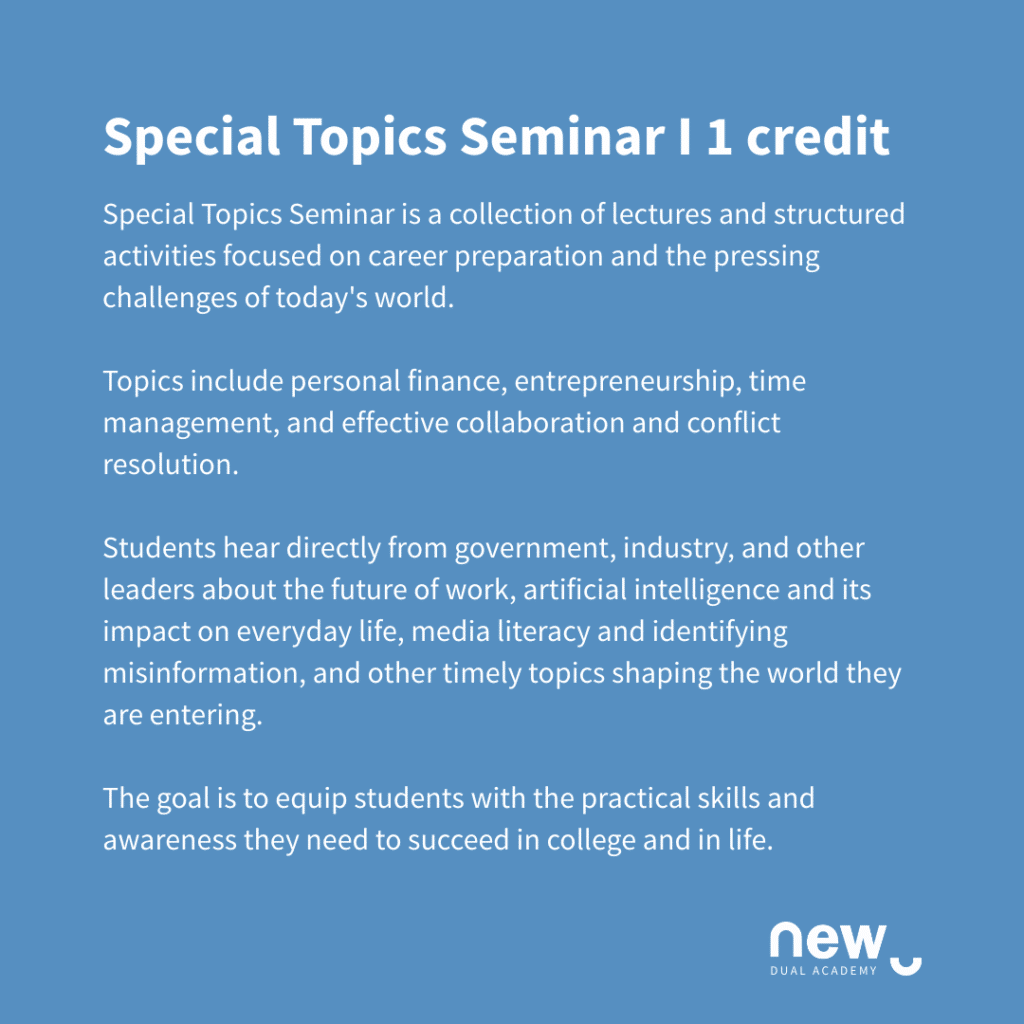
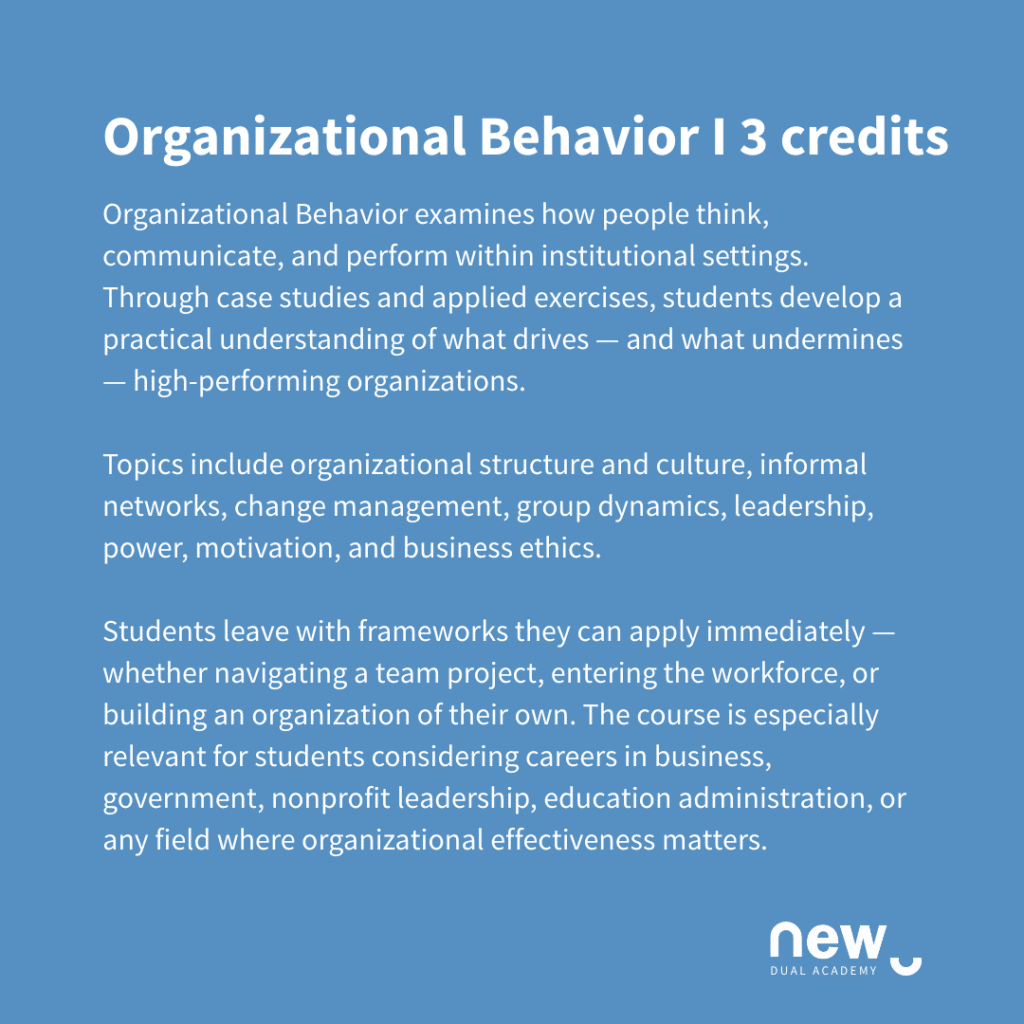


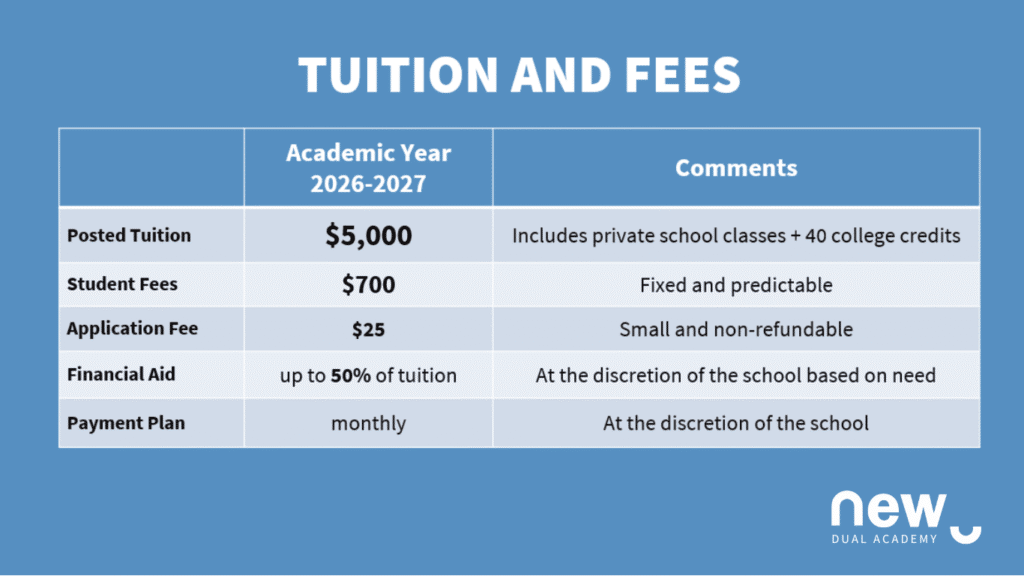
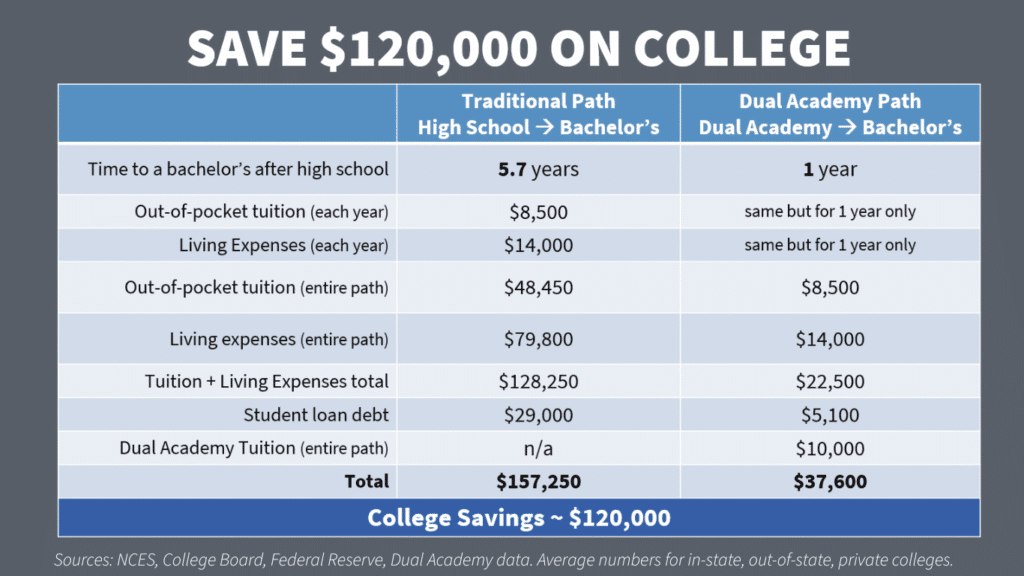
Dual Academy is accredited by Cognia. Our partner university, NewU, is accredited by the Middle States Commission on Higher Education (MSCHE).